


Healthcare Quarterly, 29(Special Issue) November 2026: 36-45.doi:10.12927/hcq.2026.27965
Improving Equity in Access to Palliative Care
The Power of the Collective: Lessons Learned From Pan-Canadian Efforts to Improve Access to More Equitable Palliative Care
Improving Equity in Access to Palliative Care Program Delivery Team (including* Clarissa Chan, Andrea Coronado, Kristen DeCaria Emilie Desmottes, Amber Heyd, Mihaela Labbe, Kirstin Loates, Tanya MacDonald, Nicole Robinson, Raquel Shaw Moxam and Lindsay Yarrow)


Abstract
This article examines the evaluation approach and learnings of the Improving Equity in Access to Palliative Care collaborative, a pan-Canadian initiative that supported 23 communities to improve palliative care access for people experiencing homelessness or vulnerable housing. Grounded in health equity and cultural safety, the collaborative developed a flexible evaluation framework with shared understanding and guiding principles. While the initiatives differed in their settings, partnerships and approaches, a common story emerged across the collaborative: when communities redesigned palliative approaches to care around the needs of people who have been structurally excluded from many current models, they expanded access, strengthened partnerships and advanced culturally safer care. The article calls for continued action: the lessons learned offer guidance for communities, organizations and partners seeking to improve equitable access to care, while reinforcing that lasting change is built through relationships, flexibility and a commitment to learning together.
Key Takeaways
- When participating communities designed care around the needs of people who were structurally excluded from many current models, they expanded access, strengthened partnerships, advanced safer care and created more person-centred approaches that better reflect the realities of the people they serve.
- There is no single path to improving equitable access to palliative care. Rather, lasting change is achieved when communities are supported to lead, adapt, learn from one another and build solutions that reflect the strengths, needs and priorities of the people they serve.
- Sustaining and expanding access to palliative care requires ongoing investment in partnerships, community leadership and knowledge sharing, alongside continued efforts to embed equitable palliative approaches to care within health and social systems.
Introduction
Across Canada, access to palliative approaches to care is not equitable, especially for people experiencing homelessness or vulnerable housing, who often face many barriers to diagnosis, treatment and support needs through existing models of palliative care. Recognizing this, Healthcare Excellence Canada (HEC) and the Canadian Partnership Against Cancer (the Partnership) formed the Improving Equity in Access to Palliative Care (IEAPC) collaborative (the IEAPC collaborative) to support community-led approaches designed specifically for and with these populations. Between 2022 and 2026, this collaborative brought together 23 communities across Canada who sought to improve access to timely, equity-oriented palliative approaches to care, reduce avoidable emergency department visits and hospital admissions, reach people who are often excluded from existing care models and support people to receive the care they need with dignity and in the environment of their choice.
All 23 communities participated in the pan-Canadian evaluation and informed the results shared within this article. In recognition of the opportunity to apply a decolonized approach to evaluation, Turtle Island Consulting Services Inc. (TICS Inc.) supported additional evaluation activities and provided evaluation support to five teams that formed the Indigenous-centred community of practice and further learnings from that work can also be found in this special edition (Caverley 2026).1 This article seeks to highlight key findings, implementation lessons as well as promising practices and overall lessons learned from the pan-Canadian evaluation.
How We Measured Impact
This mixed-methods evaluation was designed to tell the pan-Canadian impact story of the IEAPC collaborative, highlighting how participating communities advanced equitable, safer and high-quality palliative approaches to care for people experiencing homelessness or vulnerable housing. The evaluation explored the collaborative's achievements, challenges and promising practices to inform future efforts within communities and across the broader health system.
This evaluation draws on two primary sources of evidence: (1) standardized reports from teams and (2) focus groups conducted with members of the participating teams, project coaches and advisors. Together, these data sources provide both quantitative information about collaborative activities, progress and reach; and qualitative insights into implementation experiences, challenges and lessons learned. Wherever possible, opportunities to share examples and narratives were woven into data collection tools and methods.
Standardized reports
- Description: Participating teams completed regular status reports every six months to document progress, activities, outcomes and emerging learnings. These reports included both quantitative measures (e.g., number of clients reached, number of trainings delivered) and qualitative reflections (stories of impact, implementation successes, challenges and adaptations).
- Analysis as completed by Cathexis Consulting: Data from each status report were cleaned and analyzed. Quantitative data were summarized descriptively for each reporting period, while qualitative responses underwent thematic analysis to identify common patterns and emerging themes across teams. Following completion of the final status report, key quantitative indicators from all reporting periods were compiled and aggregated to produce cumulative results across the duration of the collaborative.
Focus groups with participating teams
- Cathexis Consulting, in collaboration with TICS Inc. held two rounds of focus groups.2 A series of virtual focus groups were held in September 2025, and in-person focus groups were conducted in February 2026 in Winnipeg, MB. These discussions explored participants' experiences implementing their initiatives, building partnerships, promising practices, challenges, perceived impacts and lessons learned for future work in this field.
- Analysis as completed by Cathexis Consulting:
- Analysis approaches differed slightly across the virtual and in-person focus groups. Virtual focus group recordings were transcribed and analyzed using thematic analysis. A preliminary coding approach was refined as transcripts were reviewed, allowing new concepts and themes to emerge from the data. Themes were subsequently synthesized across groups and summarized.
- For the in-person focus groups, participants contributed directly to the initial analysis through facilitated reflection activities using sticky notes and chart paper to respond to questions, identify key themes, promising practices, challenges and lessons learned. These participant-generated themes formed the foundation for subsequent analysis, which involved synthesizing and refining themes across groups to produce the final findings presented in this report.
Focus group with coaches and advisers
In February 2026, an in-person focus group was held with 12 coaches and advisers from the IEAPC collaborative in Winnipeg, MB. The purpose of this discussion was to explore coach and adviser perspectives on changes and impacts observed and identify promising practices and lessons learned for future initiatives.
- Analysis as completed by Cathexis Consulting: Participants contributed directly to the initial analysis through facilitated reflection activities using sticky notes and chart paper to respond to questions, identify key themes, promising practices, challenges and lessons learned. These participant-generated themes formed the foundation for subsequent analysis, which involved synthesizing and refining themes to produce a focus group summary. This summary was then shared back with participants for validation and additional input, prior to informing this final report.
Additional inputs
While the above methodology served as the primary sources of evidence for the evaluation, findings were also informed by a partner survey conducted by HEC, ongoing engagement with HEC and the Partnership (supporting documentation) and insights generated through parallel evaluation activities and subsequent reporting.
Evaluation Context and Framework
The IEAPC Evaluation Framework (Figure 1; HEC and CPAC n.d. 2026b) provided an important foundation for the design and implementation of the pan-Canadian evaluation work. This framework was co-developed by TICS Inc. with input from the Cohort 1 communities, Elders, coaches, Steering Committee, Evaluation Committee, patient partners, HEC and the Partnership.
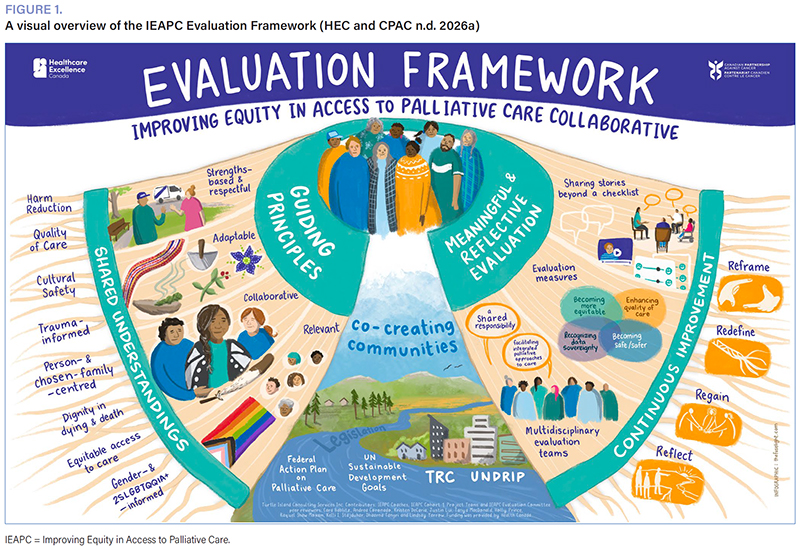
The figure depicts the IEAPC Evaluation Framework using the metaphor of a woven blanket to represent an integrated, relational and adaptive approach to evaluation. The framework centres communities of people experiencing homelessness or vulnerable housing, alongside their chosen families and care providers and illustrates the weaving together of guiding principles and shared understandings of equity-oriented palliative care. Foundational reports and declarations are positioned centrally, indicating their role in grounding the collaborative's commitments and evaluation approach.
While the framework was intentionally designed to be flexible and adaptable across diverse team contexts, several core principles informed the approach for the pan-Canadian evaluation. These included commitments to strengths-based inquiry, collaboration, adaptability and relevance to participating teams and communities, along with recognition of multiple ways of knowing and sharing knowledge (Figure 2).
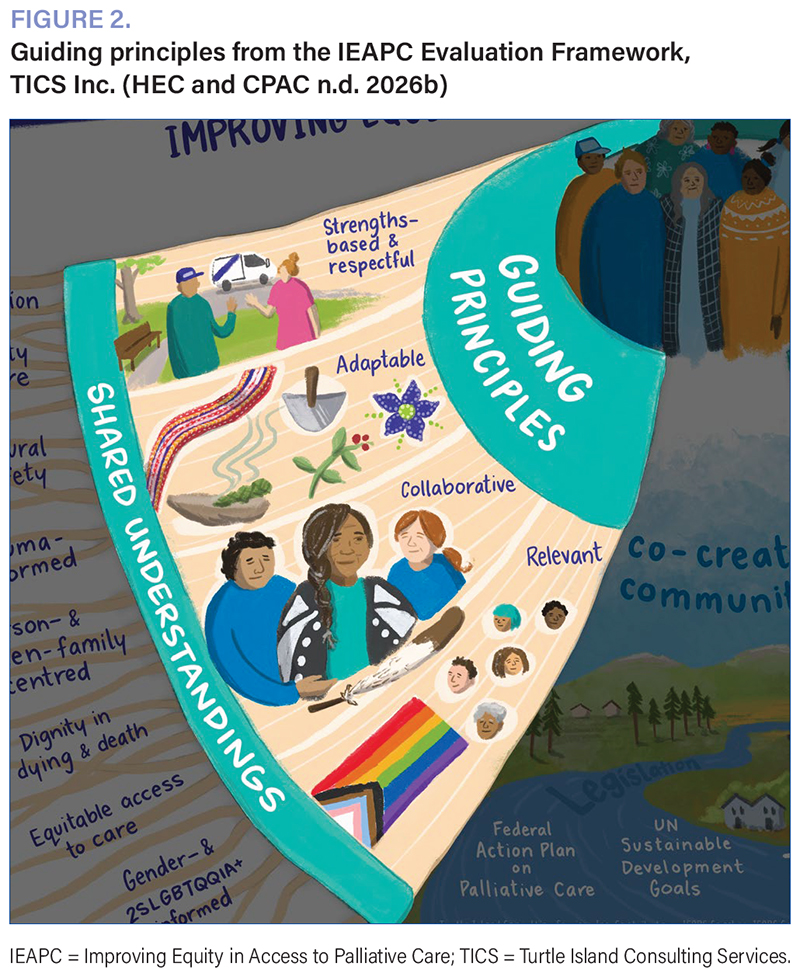
These principles shaped how the collaborative operationalized the evaluation work. Examples are as follows:
- Evaluation activities emphasized relationship-building and collaboration wherever possible
- Data collection tools and processes were designed to support teams in sharing their experiences, observations, impacts and lessons learned in ways that were meaningful and relevant to their local contexts
- Qualitative approaches emphasized reflection, storytelling and practice-based learning alongside more traditional quantitative evaluation measures and indicators (e.g., reach)
Conversations about evaluation emphasized equal interest in the journey of each team and how their initiative unfolded as the outcomes and impact of the evaluation also recognized the importance of ethical engagement and cultural safety throughout the process.
What We Found
Bringing palliative approaches to care into communities
A common thread across many of the teams was the delivery of palliative approaches to care in community, ensuring that care models were adapting to local needs, contexts and priorities, while meeting people where they were (Box 1).
| BOX 1. By The Numbers: number of people reached across four years of the IEAPC collaborative |
| 11,888 individuals reached by the 23 IEAPC teams across four years of the collaborative, including: |
| 9,019 people (76%) were direct patients, clients, family, friends or support persons who received a palliative approach to care in their community. |
| 2,869 staff members (24%) received palliative approaches to care supports or services, such as bereavement or grief services. |
| 3,750 individuals trained to meet the palliative care needs of care recipients. |
| IEAPC = Improving Equity in Access to Palliative Care. |
Creating more flexible, low-barrier and person-centred pathways to care
Across participating communities, teams described how their initiatives expanded access to palliative approaches to care for underserved populations through flexible, community-based and person-centred models, which were often delivered in non-traditional settings (e.g., mobile health vans, outdoor spaces, encampments). In many cases, the team reported that they were reaching individuals who may not have otherwise accessed care, helping people access services earlier or providing care in ways that better aligned with their needs.
Meeting people where they are
While their approaches varied, teams consistently described a shift away from expecting individuals to navigate healthcare systems on their own. Initiatives focused on reducing barriers and adapting services to meet people where they were in their community.
Community paramedics have helped me in a few different ways. They have helped me by changing my bandages for me which save's me about 20 dollars every dressing change; also they have advocated for me at the hospital so I wasn't mistreated because of being an addict (Client testimonial shared by Medavie, Health Services West – Moose Jaw).
Reducing barriers to access
Stories from teams emphasized that access to care involved more than clinical services alone. Many initiatives provided holistic care by supporting individuals with needs such as transportation, housing, obtaining identification, food security and navigating legal or probation-related requirements.
Building trust and relationships
We also heard how this work is contributing to a broader shift in how care was delivered, with an emphasis on the importance of building genuine relationships and establishing trust with clients. To do so, teams adopted more flexible, relationship-based and harm-reduction-oriented approaches to care, rather than relying primarily on existing or curative models. Mobile and outreach models were particularly important for individuals who were hesitant to engage with many current care settings or who had previously experienced barriers, stigma or distrust within healthcare settings.
Improved health and social outcomes
Team members shared examples of how these approaches to care contributed to improved health and social outcomes, with individuals receiving earlier interventions, accessing more comprehensive supports, developing trusting relationships with care providers and experiencing greater continuity of care.
The peer worker initiative created pathways for people experiencing homelessness and other vulnerable populations to access hospice care in a way that was relational, non-judgemental and trauma informed. If their patients did not have access to the hospice, they would likely have been admitted and died in an emergency department. By embedding peers with lived experience into the care team, patients who might otherwise avoid formal healthcare felt understood, respected and welcomed.
For example, peer workers accompanied patients from the streets into the hospice and to medical appointments. These medical appointments were crucial in their care journey as without them, these patients would have ended up in hospital. Peers advocated for care preferences and provided consistent emotional support which helped us build trust with patients who did not want to be here. The peers acted like a bridge between the people we serve and the care team (Second Mile Club of Toronto and Kensington Health).
In some communities, teams reported that these efforts supported improved housing stability, enhanced quality of life for both care recipients and their loved ones and reduced reliance on emergency services and other acute care settings.
Providing alternatives to emergency department care
Participating teams shared how their initiatives created alternatives to emergency department use for some care recipients. Through outreach, home visits, community paramedicine programs and improved clinical pathways and coordination among providers, individuals were able to receive support earlier and in settings that aligned with their needs.
By building networks with social workers at cancer centres, we were able to allow providers to suggest alternatives to getting care outside of the emergency department. For example, to do PICC line care, the cancer centre staff initially would say to come to ER to have this done if there was no room at the cancer centre. However, with our support, we were able to get nursing and wound care supplies at the patient's home to divert ED usage (GPS Health Navigators and Dorothy Ley Hospice).
Examples included providing wound care and nursing support in the home rather than directing patients to the emergency department and supporting families and caregivers to manage changes in health status at home. Some teams also worked with emergency medical services, community paramedics and hospital partners to create alternative pathways when urgent needs arose.
Supporting trauma-informed care
Teams described how care became safer, more responsive and more aligned with the needs, values and circumstances of the people they served. Across participating communities, teams emphasized taking trauma-informed and non-judgemental approaches to care, with dignity and respect at the centre. Safer care often began with recognizing and responding to these experiences individuals brought with them.
We now approach care through a more intentional equity and trauma-informed lens, particularly for individuals who are homeless or vulnerably housed. This has helped ensure that clients receive end-of-life care that is dignified, compassionate, nonjudgmental and high-quality, regardless of their circumstances, particularly for individuals who are homeless or vulnerably housed (Scarborough Centre for Healthy Communities and Inner City Health Associates).
Cultural safety
Beyond trauma-informed care, many teams also emphasized the importance of culturally safer and culturally meaningful approaches, particularly when supporting First Nations, Inuit and Métis care recipients, families and communities. Examples included partnering with Indigenous organizations in the community, connecting individuals and families with cultural supports and wellness programs, facilitating access to Elders and cultural resources and building staff knowledge through cultural safety training. Addressing the experiences of stigma, racism and trauma helped create safer environments where individuals felt respected and able to engage in care.
Choice, dignity and meaningful end-of-life experiences
Teams shared stories of how safer care meant supporting choice, dignity and self-determination throughout end-of-life journeys. Examples shared by teams included supporting access to culturally meaningful end-of-life practices and ceremonies (e.g., being sung home); navigating end-of-life choices such as place of death; assisting an individual in accessing medical assistance in dying as per their wishes; and a group of peer workers helping a patient fulfill a wish to write and publish a book before their death.
Supporting family members, friends, caregivers and loved ones
Across communities, teams supported loved ones by helping them navigate services, access community resources, participate in care planning, prepare for end-of-life transitions and providing grief and bereavement services before and after a loved one's death. Teams described supporting family reunification, helping loved ones travel from other parts of the country to be present at the end of life, creating welcoming spaces for overnight visits and shared family meals, coordinating cultural ceremonies, celebrations of life and other meaningful gatherings.
Building capacity and collaboration to provide equitable palliative approaches to care
The impacts of the collaborative extended beyond individual care experiences. We heard how participating in the collaborative strengthened the capacity of staff to provide equitable, low-barrier and person-centred care. Teams described increased awareness of palliative approaches to care, changes in confidence working with and delivering care to vulnerable populations and strengthened partnerships among organizations supporting underserved populations.
A key objective of the collaborative was to build the knowledge, skills and capacity required to provide equitable palliative approaches to care. Teams both participated in and delivered trainings (Box 2).
| Box 2. Number of people trained to meet palliative care needs |
| 3,750 individuals trained to meet the palliative care needs of care recipients (reported by 23 teams). |
Training topics included: Serious Illness Conversation, harm reduction, cultural competency, Advanced Care Planning, Learning Essential Approaches to Palliative Care and other tailored topics.
Across communities, teams shared examples of stronger collaboration and system-navigation skills, supported by increased awareness of available resources, clearer referral pathways and more open and intentional communication among partner organizations.
Teams described staff roles that moved beyond task-based clinical care to more integrated, interdisciplinary and intersectoral coordination. IEAPC collaborative teams also described staff becoming stronger advocates for equitable and person-centred care in their communities. Teams emphasized a shift in awareness of the need to adapt services to individual circumstances, particularly for people with histories of trauma, experiences of discrimination or complex social needs.
Increased knowledge, skills and confidence
Teams described how participating in the collaborative contributed to increased knowledge, skills and confidence among staff and partners, particularly as they relate to equity-oriented care and supporting underserved populations. Team members reported using new tools and approaches to support individuals with serious illness, raising awareness among colleagues and partners and reframing their work through an equity lens.
As a result of the training, teams noted a change in staff engagement, feeling more prepared and comfortable having end-of-life care conversations.
Lessons in implementation
Factors influencing implementation
Despite strong progress across the IEAPC collaborative, teams encountered challenges while implementing their initiatives. Teams described the realities of introducing new approaches to care within already stretched systems, while balancing the relationship-building, coordination and adaptation required to support equitable palliative approaches to care. At the same time, teams identified several factors that helped them overcome barriers and sustain momentum throughout implementation.
Common challenges: Implementation takes time, people and coordination
The work undertaken by the IEAPC collaborative teams was highly relationship-, people- and coordination-intensive.
Relationship-building: The most commonly reported implementation challenge was finding sufficient time and resources to build and sustain relationships with community partners. Developing trust and rapport with partner organizations, service providers and community members was foundational and required significant staff time, organizational resources and support from leadership.
Establishing trust with individuals facing life-limiting illnesses takes time, sensitivity, and consistent engagement. It's not only the participants who need to build trust – regional providers and the broader medical system also need time to understand and trust the navigational role (The Grey-Bruce Ontario Health Team and Brightshores Health System).
Staffing and capacity pressures: Challenges with staffing, including limited staff time and capacity, affected implementation. Many teams described balancing project activities alongside their existing responsibilities and competing organizational priorities.
Competing priorities and expectations: Teams also shared challenges with managing competing partner interests and priorities. Many partners saw value in the initiative and advocated for their own ideas, which teams had to balance with program realities.
Other challenges included working with transient populations that affected continuity of care; navigating bureaucracy, administrative barriers and siloed community services; and building shared understanding about harm-reduction, low-barrier and trauma-informed approaches.
Enabling factors: Shared learning, committed people and strong partnerships
Shared learning through the IEAPC collaborative, committed people and strong partnerships were key factors supporting teams' local implementation.
Collaborative learning and support: More than two-thirds of teams identified IEAPC supports as a key implementation facilitator, including opportunities to learn from the other teams through in-person collaborative workshops, site visits and other knowledge sharing activities.
Passionate people and supportive leadership: Several teams highlighted the importance of dedicated, passionate and engaged leadership. Collaboration between leadership and staff helped create strong foundations for implementation, while peer workers and individuals with lived experience strengthened initiatives through their unique perspectives.
Participation in the in-person collaborative sessions has re-energized our work and provided valuable opportunities to learn from others who are navigating similar challenges. These sessions have fostered connection, reflection, and renewed motivation for our team (NL Health Services – Eastern Health Rural/Urban Zones).
Strong community partnerships and shared commitment: Teams described how open communication and familiarity between partners enabled ongoing reflection on what worked, what did not and how to improve. They learned from community partners and felt supported throughout implementation.
Partnerships as a foundation for implementation
Teams consistently emphasized the importance of collaboration with local partners in designing and delivering their initiatives. These partnerships were critical for reaching individuals experiencing homelessness or vulnerable housing, helping teams identify individuals in need, in building trust, coordinating services and connecting care recipients to the supports they required. Teams noted that improving access to care required engagement beyond healthcare services, bringing together organizations and individuals from across health, housing, social services, harm reduction, municipal services, Indigenous organizations and those with living and lived experience.
I think it's really taught our community, as well as our [local health team] how important integrating with other partners, not just health partners, but the social services and beyond, how critical it is to really meeting the healthcare needs of our local population (IEAPC Team Member).
Across participating teams, 1,890 individuals were engaged in program design, delivery, and/or evaluation activities. This included at least 555 individuals with lived or living experience and 457 individuals who were identified as First Nations, Inuit or Métis.
Building and sustaining these partnerships required significant time and effort. Teams described investing in the ongoing work of establishing trust, maintaining relationships and creating opportunities for collaboration among organizations with different mandates, priorities and ways of working.
Teams emphasized the importance of flexibility and shared problem-solving in sustaining partner engagement. This was particularly important as partnerships evolved, with new organizations and sectors joining as project needs and plans evolved. Team members described how finding a common interest or priority, such as housing, can be a helpful grounding tool to bring together multiple community partners on the initiative. Rather than expecting any one organization to meet all client needs, teams focused on leveraging the strengths and resources of partners to create more coordinated and responsive systems.
Lived and living experience in program design and delivery
People with lived and living experiences played an important role in shaping the design and delivery of many IEAPC initiatives. Teams sought input through advisory groups, community tables, surveys, interviews, peer support roles and ongoing conversations with community members. This feedback helped to shape care pathways, referral processes, communication materials and service delivery approaches. Other teams involved people with lived and living experience directly in program delivery through peer worker and adviser roles, which contributed unique perspectives, helped build trust and provided practical insights to strengthen care and support.
Peer workers are now integrated into care rounds with staff. They help us reframe in a way that's really beautiful, and they'll let us know when we're saying things that can cause harm. (IEAPC Team Member).
At the same time, teams recognized that meaningful engagement did not always occur through formal structures. Several teams described initial challenges engaging people with lived experience in advisory or planning activities, noting that participation in structured meetings was not always a priority for individuals managing serious illness, housing instability or other immediate needs. As a result, teams adapted their approaches, relying on trusted relationships, community partner organizations, front-line staff and informal conversations to gather feedback and perspectives. These experiences reinforced the importance of flexibility, relationship-building and meeting people where they are when seeking to incorporate lived and living experience into program design and delivery.
Building relationships with First Nations, Inuit and Métis partners and communities
Building relationships with First Nations, Inuit and Métis communities was identified as a core component of the curriculum and collaborative design for all communities.
Many IEAPC teams worked intentionally to engage with First Nations, Inuit and Métis partners in the design, delivery and evaluation of their initiatives. Approaches varied across communities and reflected the local relationships, priorities and contexts. Examples included: involving Elders and Indigenous leaders in working groups and advisory tables; partnering with Indigenous health centres, navigators and community organizations; participating in land-based learning opportunities about Indigenous healing and decolonized approaches to care; and seeking guidance on program design, delivery and service delivery.
We have an Indigenous Elder as part of the working group. She opens all our meetings and grounds the work we do. She has been a spiritual leader and support, often creating space for working group members who have experienced vicarious trauma and burnout. Additionally, she has informed the language we use when collecting demographic information (Kingston Community Health Centres).
Engaging Indigenous navigators, cultural helpers and Indigenous-serving organizations helped to guide referrals, strengthen relationships and ensure services reflect community needs and priorities. At the same time, many teams acknowledged that building meaningful partnerships with First Nations, Inuit and Métis communities is ongoing work.
Promising Practices
As the IEAPC collaborative came to a close, participating teams, coaches and advisers reflected on what helped create change, what is needed to sustain momentum and what lessons may be valuable for others undertaking similar work in the future. This section begins by exploring sustainability and spread, including the conditions needed to maintain and build on progress. It then highlights promising practices for implementing equitable palliative approaches to care.
Looking ahead: Sustainability and spread
While plans for sustaining their initiatives varied, IEAPC collaborative team members consistently described a shift from establishing new initiatives toward embedding, maintaining and expanding upon the progress they have made. Sustainability planning focused on securing future funding, integrating equity-oriented approaches into existing systems, strengthening partnerships and sharing lessons learned with others.
Overall, teams emphasized that sustaining momentum will require continued investment, ongoing partnerships, leadership support and opportunities for shared learning. Many team members shared how the collaborative has provided the foundation for continued growth and system change.
Promising practices for local implementation
Drawing on the collective experiences of the 23 teams in the IEAPC collaborative, the following promising practices highlight approaches that supported equitable, person-centred, low-barrier and culturally safer palliative approaches to care. The promising practices below may help inform others seeking to improve equity in access to palliative care within their own communities.
- Meet people where they are. Initiatives adapted care to fit the realities of people's lives rather than expecting them to navigate traditional healthcare systems. Outreach, mobile services, shelter-based care, community paramedicine and other flexible approaches reduced barriers and connected individuals with care in comfortable, supportive settings.
- Invest in relationships, trust and community leadership. Building trust with care recipients, families, community partners and people with lived experience was foundational to success. Teams emphasized that meaningful relationships take time and are strengthened through authentic engagement, shared decision making and partnerships.
- Keep culture at the centre of care. Culturally meaningful and safer care helped ensure that services reflected the identities, values and priorities of those served. Teams described the importance of cultural safety, Indigenous navigators and cultural support roles, ceremony, language, storytelling and connections to community in supporting meaningful end-of-life experiences. They emphasized that culturally meaningful care was closely tied to safety. When care reflected an individual's culture, values, language, traditions and community connections, people were more likely to feel respected, understood and supported throughout their care journey.
- Integrate health, social, housing and community supports. Equitable palliative approaches to care require attention to the social determinants of health that influence access. Successful initiatives recognized that no single organization can address these complex needs alone, bringing together health, housing, social, cultural and community partners to provide coordinated, person-centred care and improve system navigation. Addressing these social determinants of health is key to equitable interventions, demonstrating impact and importance for this and many underserved populations.
- Build capacity through learning and knowledge sharing. Training, coaching, shared learning opportunities and communities of practice helped build staff and partner confidence and capacity. Teams also highlighted the value of storytelling and knowledge sharing as ways to strengthen relationships, support reflection and promote ongoing learning opportunities.
Considering Both Impact and Value
Improving access to palliative approaches to care directly in the community has implications beyond direct patient outcomes. Emerging evidence suggests that these approaches can also contribute to more efficient use of healthcare resources by reducing reliance on emergency and acute services. Although there was not an opportunity to complete an economic analysis of any of the 23 participating teams, an economic analysis was completed during the collaborative on three Equity-Oriented Mobile Palliative Care (EOMPC) programs in Canada that serve individuals experiencing homelessness and/or vulnerable housing (HEC and CPAC 2026a). These three programs – in Victoria, BC, Edmonton, AB, and Toronto, ON – served as models of care for promising practices that supported spread and scale in the collaborative, and each of their physicians provided coaching and mentorship support to the participating communities.
The findings of the economic evaluation found that by improving access to palliative care for underserved populations, care quality can improve, pressure on emergency services can be reduced and healthcare resources can be used more efficiently:
- Enrolment in EOMPC was associated with a 33% reduction in emergency department attendances and a 32% reduction in emergency ward admissions.
- The EOMPC programs studied generated an estimated $9,560 in net avoided emergency healthcare costs per patient, with a net return on investment of $1.65. This means that for every $1 invested in EOMPC programs, an additional $1.65 in emergency healthcare costs can be avoided elsewhere in the system (HEC and CPAC 2026a).
Together, the findings suggest that investments in equitable, community-based palliative approaches to care have the potential to generate benefits at multiple levels.
Conclusion
The IEAPC collaborative demonstrated that improving equity in access to palliative approaches to care is both possible and effective when communities are supported to design and implement solutions that reflect their local context.
Across 23 communities, teams expanded access to care for people experiencing homelessness and vulnerable housing through low-barrier, person-centred and culturally safer approaches that strengthened partnerships, built local capacity and connected health, housing, social and community services in new ways. While each community's journey looked different, a common thread emerged: meaningful change was achieved by meeting people where they are, building trusting relationships and working collaboratively across sectors to address complex needs.
The IEAPC collaborative also created opportunities for shared learning, innovation and system change. Teams consistently described increased confidence, stronger partnerships and new ways of thinking about palliative approaches to care, while the collaborative itself demonstrated the value of flexible implementation, coaching and sustained investment in relationship-building.
The work of the IEAPC collaborative provides a strong foundation for continued action. Sustaining and expanding this work will require ongoing investment in partnerships, community leadership and knowledge sharing, alongside continued efforts to embed equitable palliative approaches to care within health and social systems. The lessons learned through this collaborative offer guidance for communities, organizations and pan-Canadian partners seeking to improve equitable access to palliative approaches to care, while reinforcing that lasting change is built through relationships, flexibility and a commitment to learning and improving together.
Disclaimer
This work is supported by Healthcare Excellence Canada (HEC). HEC works with partners across the country to shape a future where everyone in Canada has safe and high-quality healthcare. We bring together people, evidence and action to move Care Forward – spreading and scaling quality and safety improvements, strengthening capacity and collective leadership and catalyzing policy and practice change. HEC is an independent, not-for-profit charity funded primarily by Health Canada. The views expressed herein do not necessarily represent the views of Health Canada.
This work is supported by the Canadian Partnership Against Cancer (the Partnership). The Partnership is an independent organization funded by the federal government to accelerate action on cancer control for all Canadians. The Partnership is the steward of the Canadian Strategy for Cancer Control (the Strategy) and works to implement the Strategy to reduce the burden of cancer on Canadians. The partner network – cancer agencies, health system leaders and experts and people affected by cancer – brings a wide variety of expertise to every aspect of our work to support multi-jurisdictional uptake of the knowledge emerging from cancer research and best practices to optimize cancer control planning and drive improvements in quality of practice across the country. The views expressed herein do not necessarily represent the views of Health Canada.
About the Author
The Improving Equity in Access to Palliative Care Program Delivery Team includes representatives from Healthcare Excellence Canada (Emilie Desmottes, Amber Heyd, Mihaela Labbe, Kirstin Loates, Tanya MacDonald, Nicole Robinson and Lindsay Yarrow) and Canadian Partnership Against Cancer (Clarissa Chan, Andrea Coronado, Kristen DeCaria and Raquel Shaw Moxam), who have contributed to the strategic development and operationalization of the Improving Equity in Access to Palliative Care pan-Canadian collaborative.
On behalf of HEC and the Partnership, Lindsay Yarrow can be reached by e-mail at ieapc-aeasp@hec-esc.ca or lindsay.yarrow@hec-esc.ca.
* in alphabetical order
Acknowledgment
The authors would like to extend their gratitude to the Improving Equity in Access to Palliative Care communities, coaches, advisers, steering committee, Elders, Turtle Island Consulting Services Inc., Cathexis Consulting and many others who contributed to the development of the Evaluation Framework and subsequent evaluation. We are grateful to participating communities for the generosity in sharing these collective learnings and impacts so that they can be shared more broadly to support organizations and communities in Canada and beyond in advancing their own equity-oriented improvement work.
References
Caverley, N. 2026. Many Paths, Walking Together: Honouring Collective Reflections in Indigenous-Centred Palliative Care in Canada. Healthcare Quarterly 29(Special Issue): 46–56. doi:10.12927/hcq.2026.27964.
Healthcare Excellence Canada (HEC) and Canadian Partnership Against Cancer (CPAC) n.d. Improving Equity in Access to Palliative Care Collaborative Evaluation Framework. Retrieved August 27, 2026. <https://a-ca.storyblok.com/f/850807391887861/e763804b85/ieapc-evaluation-framework-english-web-final-ver-3.pdf>.
Healthcare Excellence Canada (HEC) and Canadian Partnership Against Cancer (CPAC). 2026a. Investing in Equity: An Economic Analysis of Equity-Oriented Mobile Palliative Care Models in Canada. Retrieved September 15, 2026. <https://www.healthcareexcellence.ca/resources/investing-in-equity>.
Healthcare Excellence Canada (HEC) and Canadian Partnership Against Cancer (CPAC). 2026b. Listening, Learning and Walking Together: Shared Insights From an Indigenous-Centred Community of Practice on Improving Equitable Access to Palliative Care [Internal report – Not publicly available].
Footnotes
1. The Indigenous-centred Improving Equity in Access to Palliative Care Community of Practice chose to use the term “Indigenous” to respectfully represent the collective identities of First Nations, Inuit and Métis.
2. Turtle Island Consulting Services Inc. hosted dialogue sessions with the five teams from the Indigenous-centred Community of Practice; the themes from those dialogue sessions were incorporated into this report. Note: The Indigenous-centred community of practice chose to use the term “Indigenous” to respectfully represent the collective identity of First Nations, Inuit and Métis.
Comments
Be the first to comment on this!
You must sign in to comment Sign In or Create an Account to add comments
Related Content
HealthcarePapers
Reforming Governance: Careful Advice
Healthcare Quarterly
Healthcare Quarterly
Patient–Physician Relational Continuity and Health System Utilization among Patients in Alberta