


Healthcare Quarterly, 29(Special Issue) November 2026: 29-35.doi:10.12927/hcq.2026.27966
Improving Equity in Access to Palliative Care
Reflections on Innovative Models of Palliative Care Delivery


Abstract
Equity-oriented approaches and models of palliative care have emerged in Canada to address gaps in palliative care access and quality for people experiencing homelessness or vulnerable housing. These models focus on addressing the social determinants of health, trauma-informed approaches to care, harm reduction, and cultural safety. The 23 communities participating in the Improving Equity in Access to Palliative Care collaborative and their associated initiatives demonstrate a diverse range of innovative palliative care models. The effectiveness of these models across the collaborative in increasing access to safe and high-quality equity-oriented palliative care is highlighted and can serve as a foundation for similar initiatives in local contexts.
Key Takeaways
- Addressing the social determinants of health is a key palliative care intervention for people experiencing homelessness.
- Harm reduction approaches remove barriers to care.
- Trauma-informed care, cultural safety and cultural humility improve the quality of service delivery and contribute to safer care.
- Interprofessional collaborative approaches to care improve efficiency and effectiveness of palliative care delivery for people experiencing homelessness.
- Empowering people with lived experience to lead ensures that services best reflect the needs of communities being served.
Introduction
Individuals who are homeless or vulnerably housed experience complex barriers to accessing healthcare, with current care systems failing to address the social determinants of health (SDoH) that directly impact and exacerbate poor health outcomes. In the context of palliative care, services often lack trauma-informed approaches and tailored supports that effectively address the SDoH and social well-being, which can further contribute to marginalization (Peeler et al. 2023; Purkey and MacKenzie 2019; Stajduhar and Gott 2023). These gaps have resulted in inadequate care for this structurally vulnerable population and call for urgent action to improve access to equity-oriented palliative care (Stajduhar and Gott 2023).
To reduce vast disparities in access to and quality of palliative care in Canada for people who are homeless, early models of equity-oriented palliative care such as the Diane Morrison Hospice at The Ottawa Mission in 2001 (HEC 2024a) and Toronto's Palliative Education and Care for the Homeless (PEACH) Program in 2014 (HEC 2024e) have emerged and provided an informative and inspirational foundation for the Improving Equity in Access to Palliative Care (IEAPC) collaborative. The Diane Morrison Hospice, based in Ottawa, Ontario, provides palliative care grounded in compassion, kindness, dignity and acceptance through a bed-based model encompassing physical, emotional and spiritual care (The Ottawa Mission 2021). Compared with the acute care system cost per patient of $900 per day, the Hospice per patient cost was only $70 per day, resulting in cost-savings to the healthcare system of $1.39 million per year (HEC 2024a; Podymow et al. 2006). In Toronto, Ontario, PEACH is recognized as the first mobile health team in Canada to deliver palliative care to individuals experiencing homelessness or vulnerable housing at shelters, on the streets and in other non-traditional settings (Buchanan et al. 2023; Schneider and Dosani 2021). PEACH has demonstrated improved care experiences and the opportunity to alleviate strains on the healthcare system, as 64% of patients had no emergency room visits or unplanned hospital admissions, 78% of patients died in their location of choice and 83% were successfully reconnected with their family (HEC 2024e; ICHA 2016). These innovative programs and equity-oriented care models demonstrate the need to adapt flexible, person-centred care models to overcome barriers related to the SDoH and improve access to compassionate, safe palliative care.
Informed and inspired by equity-oriented initiatives in Canada as described earlier, the IEAPC collaborative was a pan-Canadian initiative aimed at addressing the significant challenges individuals experiencing homelessness and vulnerable housing face when accessing palliative care (HEC 2026b; IEAPC Program Delivery Team 2026). Funded by Health Canada and led by Healthcare Excellence Canada (HEC) and the Canadian Partnership Against Cancer (the Partnership), the IEAPC collaborative worked alongside 23 communities to transform models of care to better serve those experiencing homelessness or vulnerable housing. This article explores these initiatives in greater detail, along with their associated models of care, with an aim to elucidate how we can increase access to palliative care in additional communities across Canada.
IEAPC's Equity-Oriented Palliative Care Initiatives
The 23 IEAPC-supported initiatives (see Appendix Table 1, available online here) demonstrate a diverse range of innovative palliative care models and approaches, addressing the needs of urban, rural, remote, French-speaking, Inuit and First Nations communities across Canada. These initiatives have transformed the way that people experiencing homelessness and other structural vulnerabilities access palliative care in their respective communities (IEAPC Program Delivery Team 2026).
Although not possible within the scope of this article to explore all 23 initiatives, we highlight as many of these initiatives as possible via four main categories, or models, of equity-oriented approaches to palliative care: mobile-based and outreach services, equity-oriented clinical pathways, bed-based end-of-life care and capacity building through engagement. Of note, many of these initiatives do not neatly fit into a single category, as they are deeply informed by local contexts. These initiatives are meant to give the reader a sense of the depth and variety of initiatives and models possible with further promising practices and initiative summaries available for review and consultation (HEC 2026c).
Hospice and bed-based care: Providing dedicated care resources
Hospice and bed-based care initiatives provide palliative care services to patients and their families within specialized care environments ranging from hospitals to housing services.
The George Spady Society in Alberta offers a low-barrier, client-centred model at George's House, where up to five residents receive care in a home-like setting that provides 24-hour care from an interprofessional palliative care team for structurally vulnerable individuals at the end of life (HEC 2024b). They provide compassionate, culturally informed palliative care for people who might otherwise die without support in Edmonton (George Spady Society 2020, 2024; HEC 2026a).
In Montreal, La Maison du Père offers a continuum of services for people experiencing homelessness or at risk of becoming homeless. Over the years, the organization has developed and strengthened a range of promising practices aimed (HEC 2024c) at preventing and reducing homelessness, while promoting stability, dignity and the individuals it serves. This continuum of services includes homelessness prevention services; an emergency shelter and intake, referral, and navigation services; assistance finding and maintaining housing; social reintegration services; a residence for seniors who have experienced homelessness; as well as Accès Santé, a specialized service that addresses the health needs of people experiencing homelessness, including those requiring palliative care. To ensure continuity of care and provide services tailored to the unique realities of this population, La Maison du Père has established partnerships with The Société de soins palliatifs à domicile du Grand Montréal (Palliative Home-Care Society of Greater Montreal), the Virage Foundation, and numerous community, institutional, and hospital partners. A palliative approach is woven into the organization's culture of care. Through Accès Santé, individuals experiencing homelessness who require palliative care have access to dedicated beds and specialized support, allowing them to receive care in a safe, dignified and supportive environment.
In Halifax, Nova Scotia, the team developed a bed-based model in an existing shelter where trust and existing relationships created a natural care environment and supported clients in receiving care in their location of choice. Nova Scotia Health partnered with Adsum, Northwood, VON and other community partners and was working toward dedicated beds within the Bridge shelter to serve residents with palliative care needs. Wrap-around medical supports are on site, representing health and social system integration.
Mobile-based and outreach-based care: Bringing care to the person and community
Mobile and outreach-based initiatives involve interdisciplinary care teams delivering care in the location of the client's choice, thereby improving access, treatment and continuity of care (Buchanan et al. 2023). In the collaborative, we saw the spread of existing mobile palliative care models through the spread of the PEACH program into Scarborough (through a partnership with the Scarborough Centre for Healthy Communities and ICHA), and we also saw the development of new models in the community, such as Maison Mobile – a sustainable outreach model that enables individuals to receive palliative care in their location of choice, led by the Palliative Home-Care Society of Greater Montreal and the project's co-founder, Dr. Marie-Hélène Marchand.
In the Grey-Bruce Region of Ontario, a collective of community health and social service organizations and care providers, the Grey-Bruce Ontario Health Team, partnered with the Brightshores Health System, Saugeen First Nations, Chippewas of Nawash Unceded First Nation, Grey and Bruce Counties, Southwest Ontario Aboriginal Health Access Centre, Ontario Health at Home, Grey Bruce Hospice, Safe n’ Sound, the Grey Bruce Palliative Medicine Group and many other social and health service partners. They collaborated to assess community needs and co-design a dedicated social navigator role aimed at improving equity in access to palliative care for individuals who identify as Indigenous and/or who are homeless or vulnerably housed. The navigator position was created to directly extend a palliative approach to care for the priority populations and is a community-based mobile position (O'Connell 2026).
In contrast to Grey-Bruce's mobile navigator model, Medavie Health Services West in Moose Jaw, Saskatchewan (MHSW 2026: 12–14), uses a community paramedicine model that integrates palliative care within emergency medical services (HEC 2024d). Through its community paramedic program, the team and its partners focused on strengthening partnerships, enhancing care pathways and increasing awareness of palliative needs within community-based and non-traditional care settings through the development of wellness clinics (HEC 2024d). Over the course of the collaborative, they served over 1,800 people. By offering palliative-informed care in safe, familiar community settings, Medavie Health Services West – Moose Jaw reduced structural, cultural and psychological barriers for people who often avoid the health system due to trauma/stigma.
As part of a pilot data collection effort, four mobile and outreach teams in the collaborative asked care recipients whether “they would have sought care that day if their encounter with the initiative had not occurred.” Across these communities, 72% (n = 544) of care recipients reported that they would not have sought care that day if they had not encountered the IEAPC team. These findings provide an example of how community-based and low-barrier approaches can reach individuals who would otherwise go without the care they need (CPAC and HEC 2026).
Equity-oriented clinical pathways: Enhancing system integration
Equity-oriented clinical pathways are designed to improve system integration and care coordination by strengthening planning, development and collaboration across healthcare sectors. The pathways produced by these initiatives focus on reducing barriers to palliative care for structurally vulnerable populations by enhancing service delivery models, streamlining referral processes and incorporating lived experience into system design.
In Winnipeg, Manitoba, Winnipeg Regional Health Authority (WRHA) community outreach groups, palliative care, Indigenous Health and other non-WRHA housing and outreach groups, along with the George and Fay Yee Centre for Healthcare Innovation (n.d.), worked together to assess the need and possible responses to improving equity in access to palliative care for persons who were unhoused. They created visual tools, a low-barrier referral form and videos to improve access to care. In addition, they created a new low-barrier palliative care consult team with modified criteria for access and engagement. Importantly, they also worked to develop a process for emergency continuity care plans specific for palliative care clients to serve as a communication tool for those presenting to emergency departments for support.
Dorothy Ley Hospice and GPS Health Navigators in Greater Toronto and Hamilton Area, Ontario, address the barriers faced by refugee claimants experiencing housing insecurity when accessing palliative care. Together, these partners established a system navigation service for vulnerably housed refugees with Interim Federal Health Insurance and palliative care needs. They provided training, education and coaching sessions and focused on raising system awareness of insurance barriers for this population among community partners. With a scalable model, this program holds promising potential for expansion to additional jurisdictions.
Capacity building through engagement: Communities addressing care needs
Capacity building initiatives strengthen care planning, service development and community-driven collaboration, ensuring that palliative care approaches are informed by the lived experiences and contexts of structurally vulnerable populations.
Newfoundland and Labrador Health Services – Labrador and Grenfell Zone incorporates Inuit ways of knowing and being into palliative care delivery at the Nain Community Clinic. This initiative, within a remote Inuit community, enabled community members to receive palliative care within their community and homes, reducing the number of individuals who must travel outside of their remote community to receive palliative care. Team members described how nurses, support staff, patients, families and communities developed an understanding “that palliative care is something we can do together, that we provide competently and effectively, without community members having to ever leave the comforts of home.” Together, they integrated effective pain management through the implementation of appropriate technology, offering education to support its use and the development of Indigenous-focused end-of-life approach to ensure standardized pain management with a culturally focused, holistic approach.
In British Columbia, Vancouver Coastal Health and Providence Health Care have been co-developing serious illness care planning resources with individuals experiencing homelessness, structural vulnerability and substance use disorders in Vancouver's Downtown Eastside. By co-designing resources with people serving and living in this community, this initiative aims to ensure that end-of-life care aligns with individual preferences, while also enhancing collaboration between health and social care teams.
In Alberta, Alberta Health Services partnered with Cold Lake First Nation to improve palliative care access in the local community. This initiative supported cultural safety and trauma-informed training for providers, engagement with local Elders and collaborative solutions to address systemic gaps in providing equitable palliative care. Their efforts have improved more choice for individuals living on Cold Lake First Nation to receive culturally safer palliative care within their community.
Innovation and Impact of Equity-Oriented Palliative Care Initiatives
At the core of equity-oriented approaches to palliative care, we have seen within the collaborative a set of common themes that inform their effectiveness and sustainability. These themes help us better understand how we can design more impactful and innovative care models, especially for underserved communities. As we discuss these principles, we will also highlight initiatives within the IEAPC collaborative that show how these principles can be embedded in real-world environments.
Addressing social determinants of health as a palliative care intervention
There is an explicit focus on addressing SDoH across initiatives. Factors including housing instability, poverty, education, employment and access to social supports directly impact an individual's health outcomes and ability to access care (Draper et al. 2024). For First Nations, Inuit and Métis, colonialism is recognized as the underlying factor driving all other determinants, health disparities and inequitable access to healthcare (Browne et al. 2016). Standard healthcare delivery models often fail to meet the needs of individuals without a fixed address; for instance, the inability to access a phone can create barriers to scheduling appointments, receiving follow-up care or coordinating care. In addition, certain treatments, such as chemotherapy, may be inaccessible for individuals who lack a stable residence. For example, Newfoundland and Labrador Health Services in St. John's recognizes housing instability as a critical barrier to end-of-life care by providing dedicated palliative care shelter beds for people experiencing homelessness. This approach ensures dignified, person-centred care while also reducing unnecessary hospitalizations and emergency department visits, demonstrating the value of integrating the SDoH into palliative care delivery for more sustainable, cost-effective healthcare delivery.
Harm reduction
Harm reduction ensures that individuals who use substances can receive non-judgemental, compassionate and person-centred care and is a foundational principle of many equity-oriented palliative care models (Bartlett et al. 2013). By prioritizing trust, harm reduction approaches remove barriers to care and lead to safer, more inclusive care environments (Hawk et al. 2017). In Victoria, the Cool Aid Society works to integrate harm reduction principles with trauma-informed care, ensuring that palliative care environments remain safe, inclusive and responsive to the needs of individuals who use substances. Such practices can include supporting clinicians in ensuring that, regardless of substance use status, providers are comfortable facilitating access to prescribed medication and treatment. By acknowledging the complex realities faced by structurally vulnerable populations, these initiatives provide care that is rooted in love, dignity and understanding, rather than judgement or exclusion.
Trauma-informed care, cultural safety and cultural humility
Trauma-informed care, cultural safety and cultural humility are also fundamental components of equity-oriented palliative care initiatives, ensuring that services are responsive to the lived experiences and cultural identities of structurally vulnerable populations (de Groot et al. 2023). For example, Fort Erie Native Friendship Centre and Hospice Niagara integrated cultural safety into their initiative by incorporating First Nations, Métis and Inuit practices, land-based healing and culturally relevant spaces that inspire connections to language, community and spiritual beliefs. The volunteer program developed recognizes that impactful models of palliative care for Indigenous communities must be community-driven, ensuring that services align with Indigenous ways of knowing, being and doing. As reinforced by Prince (2026) and Caverley (2026), by centring First Nations, Inuit and Métis knowledges and perspectives, these initiatives build trust, foster meaningful engagement and contribute to improved health outcomes, ultimately reducing disparities in palliative care access and delivery.
Interprofessional, collaborative approaches to care
Interprofessional collaboration is a defining feature of these initiatives, uniting nurses, volunteers, paramedics, physicians, counsellors, social workers, volunteers, peer workers and hospice aides to deliver comprehensive and coordinated care. For example, Nova Scotia Health Authority has embedded clinical staff, including a nurse practitioner, into the Bridge shelter, allowing health and social services to bring their interprofessional team together to better meet the needs of clients. This collaborative, multidisciplinary approach enhances the efficiency and effectiveness of palliative care delivery by addressing the physical, emotional, social and spiritual dimensions of well-being.
Empowering people with lived experiences to lead
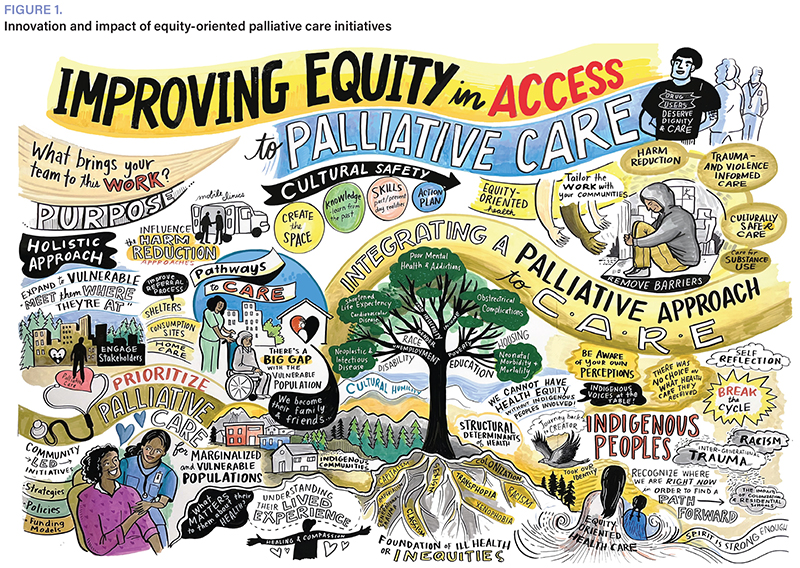
We also see the importance of engaging and empowering individuals with lived experience to lead in the design and implementation of services. By actively involving community members, peer workers and Elders, these models ensure that care delivery is responsive, relevant and meets people where they are at (Haldane et al. 2019). The impact of lived experience as wisdom and leadership is illustrated in Figure 1, which visually represents the multi-faceted factors influencing equitable access to palliative care (illustrated by ThinkLink). Julie Diner shared her experience as an individual with lived experience as a member of the Palliative Advocacy and Care Team (PACT) program in Thunder Bay (Diner 2026; HEC 2024f). She speaks about how collaboration with peer workers and community organizations to co-develop resources for serious illness care planning ensures that services and resources align with the needs and preferences of marginalized populations. By centring community voices (Thunder Bay PACT 2024), these initiatives enhance efficiency, lower costs and improve health outcomes. Notably, when programs are designed by and for specific communities, they are more likely to be utilized and effective as they reflect the unique needs and values of those they intend to serve (Haldane et al. 2019).
A Call to Action
To maintain the momentum and sustain the impactful work of the IEAPC collaborative and respective communities, it is important for future initiatives to prioritize sustainability, scalability and consider robust evaluation frameworks (IEAPC Program Delivery Team 2026). The IEAPC Evaluation Framework includes decolonized evaluation approaches involving mixed-method data sources, such as story sharing, to share the impact of the collaborative and can be used outside of the collaborative to support communities in measuring their improvement and capturing their journey to create more equitable, high-quality and safe care (IEAPC Program Delivery Team 2026). In addition, learnings and innovative models from this collaborative can be adapted in local communities and applied as a blueprint for future work focused on equity-oriented care for individuals experiencing homelessness or vulnerable housing. We have an obligation to use our power and privilege to design and deliver more equitable palliative care so that everyone has access to the palliative care they need and deserve. Access to safe and high-quality palliative care cannot and should not be dependent on our housing status.
Moving Forward
In conclusion, the IEAPC collaborative highlights the impact that equity-oriented initiatives can have on access to safe and high-quality palliative care across diverse communities experiencing homelessness or vulnerable housing. These innovative, equity-oriented approaches to care demonstrate the effectiveness of integrating trauma-informed care that recognizes and addresses the SDoH. This delivery of care is also strengthened through encompassing aspects of harm reduction, cultural safety, lived experience and incorporating circles of care fostered by cross-collaboration.
Through the sharing of key components, learnings and new approaches arising from the IEAPC collaborative, momentum for improving equity-oriented palliative care continues to grow. With this collaborative serving as a foundation, the adaptation and scalability of similar initiatives in local contexts are encouraged to continue progress toward a healthcare system that is inclusive, compassionate and provides all individuals with access to safe, high-quality palliative care.
Finally, it is important to acknowledge that the IEAPC collaborative and its accomplishments would not be possible without the financial and strategic support of Health Canada, CPAC and HEC, whose investments in community-led approaches and cross-sector collaboration have contributed a pivotal role in improving equity-oriented palliative care delivery for populations experiencing homelessness or vulnerable housing.
About the Author
Seana Bulle, MD, CCFP(PC), BHSc, is an academic family physician and palliative care physician at St. Michael's Hospital in Toronto, ON.
Naheed Dosani, MSC, MD, CCFP(PC), FCFP, BSc, is a palliative care physician at St. Michael's Hospital, Unity Health Toronto, Toronto, ON, and a health equity adviser with the Canadian Partnership Against Cancer, Toronto, ON, with a focus on improving equitable access to palliative care for structurally vulnerable populations.
Naheed Dosani can be reached by e-mail at naheed.dosani@unityhealth.to.
References
Bartlett, R., L. Brown, M. Shattell, T. Wright and L. Lewallen. 2013. Harm Reduction: Compassionate Care of Persons With Addictions. Medsurg Nursing 22(6): 349–58.
Browne, A.J., C. Varcoe, J. Lavoie, V. Smye, S.T. Wong, M. Krause et al. 2016. Enhancing Health Care Equity With Indigenous Populations: Evidence-Based Strategies From an Ethnographic Study. BMC Health Services Research 16: 544–60. doi:10.1186/s12913-016-1707-9.
Buchanan, N., N. Dosani, A. Bond, D. Spaner, A. Tedesco, N. Persaud et al. 2023. Palliative Education and Care for the Homeless (PEACH): A Model of Outreach Palliative Care for Structurally Vulnerable Populations. Healthcare Quarterly 26(1): 24–30. doi:10.12927/hcq.2023.27055.
Canadian Partnership Against Cancer (CPAC) and Healthcare Excellence Canada (HEC). 2026. Improving Equity in Access to Palliative Care Collaborative: A Story of Collective Impact [Internal Document].
Caverley, N. 2026. Many Paths, Walking Together: Honouring Collective Reflections in Indigenous-Centred Palliative Care in Canada. Healthcare Quarterly 29(Special Issue): 46–56. doi:10.12927/hcq.2026.27964.
de Groot, J.M., D.C. Fehon, L. Calman, D.S. Miller and A. Feldstain. 2023. Trauma-Informed Palliative Care Is Needed: A Call for Implementation and Research. Palliative Medicine 37(10): 1470–73. doi:10.1177/02692163231206998.
Diner, J. 2026. Bridging the Gap: Why Lived Experience Is Essential in Palliative Care for the Unhoused. Healthcare Quarterly 29(Special Issue): 11–14. doi:10.12927/hcq.2026.27969.
Draper, E.C., H.J. Burgess, C. Chisholm, E.L. Mazerolle and C. Barker. 2024. Front-Line Insights Into the Social Determinants of Health in Housing Instability: A Multi-Province Study. Journal of Primary Care & Community Health 15. doi:10.1177/21501319241292131.
George and Fay Yee Centre for Healthcare Innovation. n.d. Your Centre for Health Research and Health System Improvement. Retrieved August 31, 2026. <https://chimb.ca/>.
George Spady Society. 2020. George's House Palliative Care Program. Retrieved August 31, 2026. <https://www.gspady.org/georges-house-1>.
George Spady Society. 2024. A Morning at George's House. YouTube. Retrieved December 5, 2025. <https://www.youtube.com/watch?v=I1etuhihHsY>.
Global News. 2025, November 24. Montreal Health-Care Program Offers Palliative Care to the Unhoused. Retrieved August 31, 2026. <https://globalnews.ca/video/11541914/montreal-health-care-program-offers-palliative-care-to-the-unhoused/>.
Haldane, V., F.L.H. Chuah, A. Srivastava, S.R. Singh, G.C.H. Koh, C.K. Seng et al. 2019. Community Participation in Health Services Development, Implementation, and Evaluation: A Systematic Review of Empowerment, Health, Community, and Process Outcomes. PLoS One 14(5): e0216112. doi:10.1371/journal.pone.0216112.
Hawk, M., R.W.S. Coulter, J.E. Egan, S. Fisk, M.R. Friedman, M. Tula et al. 2017. Harm Reduction Principles for Healthcare Settings. Harm Reduction Journal 14: 70. doi:10.1186/s12954-017-0196-4.
Healthcare Excellence Canada (HEC). 2024a. Promising Practice: Diane Morrison Hospice. Retrieved August 31, 2026. <https://a-ca.storyblok.com/f/850807391887861/27dc221788/promisingpractice-dianemorrisonen-20240102v3.pdf>.
Healthcare Excellence Canada (HEC). 2024b. Promising Practice: George's House. Retrieved August 31, 2026. <https://a-ca.storyblok.com/f/850807391887861/cc0e72c73c/pp-georgeshouseen2024v2.pdf>.
Healthcare Excellence Canada (HEC). 2024c. Promising Practice: La Maison du Père. Retrieved August 31, 2026. <https://a-ca.storyblok.com/f/850807391887861/da8f7ed1d5/pp-maison-du-pereen-2024v2.pdf>.
Healthcare Excellence Canada (HEC). 2024d. Promising Practice: Medavie Community Paramedicine (Improving Equity in Access to Palliative Care – Wellness Clinics). Retrieved August 31, 2026. <https://a-ca.storyblok.com/f/850807391887861/d3fe16c0d9/promisingpractice-medavieen-20240102v3.pdf>.
Healthcare Excellence Canada (HEC). 2024e. Promising Practice: Palliative Education and Care for the Homeless (PEACH). Retrieved August 31, 2026. <https://a-ca.storyblok.com/f/850807391887861/2d7aa501cc/pp-peachen-2024v2.pdf>.
Healthcare Excellence Canada (HEC). 2024f. Promising Practice: Thunder Bay Palliative Advocacy & Care Team (PACT). Retrieved August 31, 2026. <https://a-ca.storyblok.com/f/850807391887861/b9ba645bb1/promisingpractice-pacten-20240102v5.pdf>.
Healthcare Excellence Canada (HEC). 2026a, March 27. From Framework to Impact: Equity Oriented Care in Practice. Retrieved August 31, 2026. <https://www.youtube.com/watch?v=_Sg9RRMKCtw&t=2s>.
Healthcare Excellence Canada (HEC). 2026b. Improving Equity in Access to Palliative Care. Retrieved August 30, 2026. <https://www.healthcareexcellence.ca/programs/improving-equity-in-access-to-palliative-care/>.
Healthcare Excellence Canada (HEC). 2026c. Promising Practices for Improving Equity in Access to Palliative Care. Retrieved August 31, 2026. <https://www.healthcareexcellence.ca/resources/improving-equity-in-access-to-palliative-care-promising-practices/>.
Improving Equity in Access to Palliative Care (IEAPC) Program Delivery Team. 2026. The Power of the Collective: Lessons Learned From Pan-Canadian Efforts to Improve Access to More Equitable Palliative Care. Healthcare Quarterly 29(Special Issue): 36–45. doi:10.12927/hcq.2026.27962.
Inner City Health Associates (ICHA). 2016. Annual Report 2015–2016 [Report]. Retrieved August 30, 2026. <https://www.icha-toronto.ca/new-site/wp-content/uploads/Annual-Report-2015-2016-External_0.pdf>.
Medavie Health Services West [MHSW]. 2026. Mobile Integrated Health Program Community Paramedicine Program Booklet. Retrieved August 31, 2026. <https://medaviewest.ca/files/images/MobileIntegratedHealthProgram_booklet.pdf>.
O'Connell, E. 2026, March 4. Walking With People – Equity in Palliative Care in Grey and Bruce (IEAPC) [Video]. Retrieved September 2, 2026. <https://vimeo.com/1170460333/e3ffa971dd?share=copy&fl=sv&fe=ci>.
Peeler, A., A. Doran, L. Winter-Dean, M. Ijaz, M. Brittain, L. Hansford et al. 2023. Public Health Palliative Care Interventions That Enable Communities to Support People Who Are Dying and Their Carers: A Scoping Review of Studies That Assess Person-Centered Outcomes. Frontiers in Public Health 11: 1180571. doi:10.3389/fpubh.2023.1180571.
Prince, H. 2026. Engaging in a Relational Approach: Addressing Inequities in Access to Palliative Care for Indigenous Peoples. Healthcare Quarterly 29(Special Issue): 15–21. doi:10.12927/hcq.2026.27968.
Podymow, T., J. Turnbull and D. Coyle. 2006. Shelter-Based Palliative Care for the Homeless Terminally Ill. Palliative Medicine 20(2): 81–86. doi:10.1191/0269216306pm1103oa.
Purkey, E. and M. MacKenzie. 2019. Experience of Healthcare Among the Homeless and Vulnerably Housed a Qualitative Study: Opportunities for Equity-Oriented Health Care. International Journal for Equity in Health 18(1): 101. doi:10.1186/s12939-019-1004-4.
Schneider, E. and N. Dosani. 2021. Retrospective Study of a Toronto-Based Palliative Care Program for Individuals Experiencing Homelessness. Journal of Palliative Medicine 24(8): 1232–35. doi:10.1089/jpm.2020.0772.
Stajduhar, K. and M. Gott. 2023. Closing the Health Equity Gap in Palliative Care: The Time for Action is Now. Palliative Medicine 37(4): 424–25. doi:10.1177/02692163231164729.
The Ottawa Mission. 2021. The Ottawa Mission Hospice at 20 Report [Report]. Retrieved August 31, 2026. <https://ottawamission.com/wp-content/uploads/2026/06/Hospice-Report-20-Years.pdf>.
Thunder Bay Palliative Advocacy and Care Team (PACT). 2024. Vulnerably Housed Promo [Video]. Retrieved August 29, 2026. <https://vimeo.com/899861505/b68c4df190?share=copy>.
Comments
Be the first to comment on this!
You must sign in to comment Sign In or Create an Account to add comments
Related Content
HealthcarePapers
HealthcarePapers
Social Prescribing and the Welfare State
Nursing Leadership
Connecting to Meaning and Purpose Through Mission and Values Alignment