


Healthcare Policy
Electronic Access to and Exchange of Patient Information Among Physicians Practising in Canada
Waldo Beausejour, Bobby Gheorghiu, Owen Adams, Rashaad Bhyat and Simon Hagens
Abstract
Physicians require timely access to patient information to provide effective care. However, in Canada, most of this information is siloed in unconnected systems, limiting access at the point of care. This paper analyzes the current state of electronic access to and exchange of patient information among Canadian physicians, using data from the 2024 Infoway-Canadian Medical Association survey of physicians. Using descriptive analysis, the paper reveals an imbalance between the growing adoption of digital health solutions (notably electronic medical records and electronic health records) and advancements in interoperability. To achieve a more connected digital health ecosystem, the paper calls for policy efforts, data-sharing frameworks and incentive strategies.
Introduction
Background
Physicians need access to all relevant patient information for timely and effective care. With the increasing digitization of Canadian healthcare information management, most of this information now resides in digital systems (Competition Bureau Canada 2022). However, a significant amount of Canada's patient health information is still stored across a range of systems that do not easily connect or share data (Canada Health Infoway 2023). Therefore, while patient data are predominantly electronic, accessing a comprehensive view of that information in its digital form at the point of care remains a challenge for physicians. This challenge restricts their ability to deliver high-quality care, creating health data interoperability issues that limit the effectiveness of digital technologies on health outcomes (Iyamu et al. 2024). A recent systematic review confirms “the need for broader connectivity across the healthcare ecosystem” (Gnanlet and Choi 2025). Canadians feel the impact, with 25% reporting that they have been frustrated repeating information, 18% reporting that a provider was missing important information and 16% reporting that their time was wasted because information was not shared effectively (Canada Health Infoway 2023).
In 2022, the Commonwealth Fund International Survey found that 36% of Canadian general practitioners (GPs) could exchange patient summaries. This was well below the international average, with leaders such as the UK, Netherlands, New Zealand and Sweden, all above 80%. Canadian physicians have caught up with peers in the adoption of electronic records, but many lag in connectivity (Commonwealth Fund 2019). The US National Electronic Health Records Survey has been used to monitor progress and inform policy development around interoperability (U.S. National Center for Health Statistics and National Electronic Health Records Survey 2019). The data demonstrated value from the information sharing and illustrated the important gaps to fill (Pylypchuk et al. 2022). Surveys or assessments of physicians around digital health and interoperability can also be found in the UK, Germany and Australia, and similarly play an important role in understanding progress, gaps and physician needs (Graf et al. 2023; Li et al. 2025; Tran et al. 2025).
Health data interoperability (hereafter referred to as interoperability) refers to the capacity of diverse information entities to share, integrate and collaboratively use data to improve individual and population health (Canadian Medical Association et al. 2024). Several initiatives aim to advance interoperability, including the federally supported Pan-Canadian Health Data Strategy, which focuses on common data policy frameworks and interoperability standards (Iyamu et al. 2024). The Shared Pan-Canadian Interoperability Roadmap, led by Canada Health Infoway (Infoway), aims to improve provider and patient access to patient data (Canada Health Infoway 2023). Moreover, the proposed Connected Care for Canadians Act, Bill C-72, introduced by the federal government (Health Canada 2024), exemplifies potential legislation to support interoperability.
Concurrently, primary care delivery is evolving from a family physician-centric model to a team-based, inter-professional approach (CIHI 2024), incorporating professionals such as nurse practitioners, pharmacists and community health workers (Aggarwal et al. 2023). The 2022 Commonwealth Fund Survey found that over half (52%) of Canadian family physicians now collaborate with other professionals, such as nurses and case managers, for chronic disease management (CIHI 2023). This increasing interdisciplinary collaboration necessitates seamless data access and sharing.
Objectives
The objective of this paper is to examine the current state of electronic access to and exchange of patient information among physicians in Canada using data from the 2024 Infoway-CMA National Survey of Canadian Physicians (Canada Health Infoway and Canadian Medical Association 2024). Specifically, the study describes and analyzes physicians' adoption and use of electronic medical records (EMRs), electronic health records (EHRs) and other digital health solutions to access, retrieve and share patient health information across care settings.
In this descriptive analysis, we sought to identify gaps in clinical interoperability and understand barriers faced by Canadian physicians when accessing and sharing patient health information. The findings are used to inform policy directions for strengthening data sharing, system integration and future digital health innovation, including emerging technologies and clinician-led governance.
Methods
Data source
We analyzed data from the 2024 National Survey of Canadian Physicians, a cross-sectional survey conducted by Infoway in collaboration with the CMA. The survey tracked physician adoption and use of digital health technologies, with a particular focus on interoperability and its impact on clinical practice. It also collected demographic data, including specialty, main practice setting, age, gender and geographic location.
To contextualize trends over time, we used results from previous iterations of the survey conducted in 2017 (N = 7,184) by the CMA and 2021 (N = 2,071) to assess progress in patient data access and information exchange.
Survey population and sample
The survey population included physicians and residents – GPs, family physicians (FPs), specialists (medical and surgical) – providing direct patient care across Canada. The survey was distributed to 45,283 practising physicians and residents identified through the CMA membership database. A total of 1,145 respondents completed the survey, including 559 GPs/FPs, 531 specialists and 55 residents, corresponding to a response rate of 3%.
Survey instrument and data collection
Infoway and CMA jointly developed the three-part survey questionnaire (a full description of the questionnaire is provided in the Appendix, available online at here). The first part collected respondent demographics and practice characteristics. The second part captured information on the use of digital health technologies (including EMRs and EHRs), as well as barriers and challenges that limit physicians' ability to realize full value from these technologies; this section also included a burnout question derived from the validated Mini-Z instrument. The third section collected data on the integration of artificial intelligence (AI)-powered technologies in clinical practice. The first two parts relied primarily on multiple-choice questions, while the third used four-point Likert scale items.
The survey format was an online questionnaire that was available in both English and French and was compliant with the Accessibility for Ontarians with Disabilities Act (AODA). Infoway contracted a third-party market research firm (Leger) to program and manage the online survey and oversee fieldwork. The CMA engaged Torpedo Marketing to distribute the survey via e-mail invitations to CMA members between April and May 2024, with the survey link embedded in the invitation e-mail.
An independent research ethics board (Veritas IRB Inc.) granted ethics approval before data collection (tracking number 2024-3530-17865-3). Infoway and the CMA pretested the questionnaire with a convenience sample of 10 CMA-member physicians to assess clarity and validity, and to identify and correct issues in the draft instrument.
Data analysis
We conducted descriptive analyses using summary statistics, including percentages, proportions and averages, and used graphical displays to characterize the current state of electronic access to and exchange of patient information among physicians in Canada. We performed data cleaning, processing and analysis using the Statistical Package for the Social Sciences (SPSS) version 29 and used Microsoft Excel 365 for data visualization. We applied post-survey weights calculated from CMA membership population data (specialty, region, age and gender) to ensure representativeness. Where appropriate, we disaggregated results using respondent demographic characteristics to compare patterns across physician groups.
Results
Electronic clinical solutions for patient care support
In 2024, nearly all physicians (95%) used EMRs/EHRs to enter and retrieve clinical notes, an increase from 82% in 2017 (Canada Health Infoway and Canadian Medical Association 2024) and averaging a 10.5 percentage point growth during the 2017–2024 period. Long-term Infoway trend data showed a steady rise in electronic patient record adoption among both GPs, increasing from 16% in 2004 to 97% in 2024, and specialists, increasing from 24% in 2007 to 93% in 2024 (Appendix 1, Figure 1, available online at here).
Physicians also reported access to other electronic clinical solutions to support patient care. Nearly three-quarters (72%) electronically ordered laboratory and diagnostic tests and 60% reported using electronic clinical decision support tools, both reflecting substantial increases since 2021. Approximately two in five physicians (40%) used electronic medication reconciliation tools.
For patient engagement and management solutions, more than one-third of physicians (37%) used secure e-mail or messaging to communicate with their patients, and over one-quarter (27%) generated complete patient lists for monitoring and follow-up. While one-quarter (25%) used online appointment scheduling, only 10% offered online prescription renewal services. Most physicians (80%) used electronic systems only to document patient information, with approximately two-thirds relying on one system and 14% combining multiple systems (Appendix 1, Figure 2, available online at here).
Electronic mechanisms for clinical communication
Nearly three-quarters of physicians reported electronically sending/receiving lab and diagnostic results, and half reported sending/receiving visit and discharge information electronically (Table 1). Two-fifths of physicians used electronic referrals to request/receive care from specialists and over two-fifths sent electronic prescriptions and renewals directly to community pharmacies. Over one in three physicians accessed patient information from outside their main practice, while over one in four exchanged patient clinical summaries with external providers (Table 1).
| TABLE 1. Physicians using clinical care communications between providers that occurs electronically directly to/from their practice system, % of physicians | ||
| Accessing patient information | 2024 | 2021 |
|
73% | 78% |
|
50% | 57%1 |
|
43% | – |
|
39% | – |
|
38% | – |
|
35% | – |
|
34% | – |
|
29% | – |
| E-referrals/consults and exchange of info with other settings | ||
|
40% | 37%2 |
|
37% | – |
|
29% | 35%3 |
|
24% | 24%2 |
|
23% | – |
| Prescriptions/communication with community pharmacy | ||
|
41% | 33%4 |
|
18% | 14% |
| Extracting patient data from EMR | ||
|
23% | – |
|
20% | – |
| CPP: Cumulative Patient Profile/history data to share with other providers as standardized PS: Patient Summary | 14% | – |
|
13% | – |
| None of the above | 12% | – |
| Not applicable | 2% | – |
| Base: Total physicians | 1,145 | 2,071 |
| Notes: Results from 2021 are presented in the last column to illustrate progress over time. A dash (“-”) indicates that the item or indicator was not collected in the 2021 iteration of the survey. Caution is advised when comparing results with the 2021 survey, as the wording of some items was slightly modified in 2024. The statements used in the 2021 iterations were as follows: | ||
| 1 Receipt of hospital visit and discharge information; | ||
| 2 E-referrals to request/receive care from specialists/physicians; | ||
| 3 Exchange of patient clinical summaries with doctors outside practice; | ||
| 4 Send and receive electronic messages/notes from pharmacy. | ||
| EMR = electronic medical record; QI = quality improvement. | ||
| Source: Canada Health Infoway and Canadian Medical Association 2024. | ||
Persistent interoperability gaps
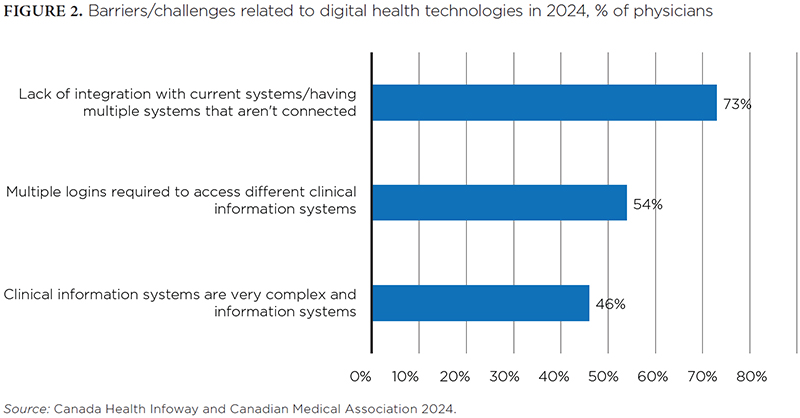
Physicians reported multiple barriers and challenges that limited their ability to access, use or derive full value from digital health technologies. Nearly three-quarters (73%) of physicians identified poor system integration or the use of multiple unconnected systems as a barrier (Figure 2). More than half reported challenges related to multiple logins to access different clinical information systems, and less than half (46%) reported issues related to systems that were complex or not intuitive (Figure 2).


When aggregated, interoperability-related issues (including lack of system integration, multiple logins and poor usability) were reported by 89% of physicians. These challenges were more frequently reported by hospital-based physicians (92%) than by those working in community settings (87%) but were reported at similar levels by GPs/FPs and specialists (both 89%) (Canada Health Infoway and Canadian Medical Association 2024). A complete list of reported digital health barriers and challenges is provided in Appendix 1, Figure 3, available online at here).
Beyond these system-level challenges, physicians reported spending an average of 86 additional minutes per day beyond what they felt should be spent searching for patient information, with over a third spending two or more hours. Physicians who could digitally exchange patient clinical summaries spent, on average, over 13% less time searching for patient information outside their practice. Physicians reported needing access to external health information for over half (52%) of their patients, on average, in the past 12 months (Canada Health Infoway and Canadian Medical Association 2024).
In addition, 51% of EMR/EHR users reported spending two or more hours at home after work using these systems. Physicians spending three or more hours after their regular working hours were almost three times as likely to report burnout compared to those spending less than one hour (11.4% vs 3%), indicating a potential association between EMR/EHR use at home and burnout. Overall, 44% of physicians reported feeling burned out to some extent, including 5% who reported feeling completely burned out (Appendix 1, Figure 4, available online at here).
Discussion
The 2024 Infoway-CMA National Survey of Canadian Physicians reveals substantial progress in the adoption of digital health tools such as EMRs/EHRs, reflecting sustained investments by pan-Canadian organizations and provincial/territorial governments (Chang and Gupta 2015). A notable example is the federal government's 2010 Economic Action Plan, which funded Infoway to co-invest with provinces/territories and providers to support EMR adoption (Zelmer and Hagens 2014).
Despite this progress, challenges remain. The survey shows that only 29% of physicians could share patient summaries outside their practice, while 44% reported burnout to some extent (Canada Health Infoway and Canadian Medical Association 2024). These findings, alongside increased EMR/EHR adoption, indicate a disconnect between digital adoption and system-wide integration. They also point to fragmented systems hindering access to patient information, contributing to burnout. As Hagens (2024) notes, without supportive environments for data sharing and innovation, technology can exacerbate existing pressures. Meaningful digital transformation requires addressing systemic barriers while supporting clinicians in using these technologies effectively.
Past experience with EMR adoption shows success depends on strong change management, including financial and non-financial supports (Bhyat et al. 2021). Ongoing misalignment between clinician costs and system-level benefits continues to hinder adoption, especially in a resource-constrained digital health environment. Future efforts must unite governments, clinician groups, vendors and regulators to create a system that is connected, efficient and meets the needs of patients and providers alike. The Digital Health Interoperability Task Force has recognized this as a national priority (CMA et al. 2024).
Policy and legislative actions are needed to accelerate integration. Bill C-72, the previously introduced Connected Care for Canadians Act, took a step toward mandating better data sharing (Health Canada 2024), but it will need to be reintroduced in a future session of Parliament before it can become law. Any proposed policies or legislation must enforce national data standards, ensure compliance and fund integration. Moreover, future policy efforts should extend beyond physicians to ensure that EMR/EHR interoperability frameworks and data-sharing initiatives support the full range of healthcare professionals engaged in patient care. Evidence from studies in Canada and internationally suggests that access to EMRs by other health professionals, including nurses and pharmacists, is equally critical to achieving integrated, team-based care (Kosteniuk et al. 2023; Singer and Fernandez 2015; Torkman et al. 2025). Ensuring that EMR systems are designed to meet the needs of the entire care team, not just physicians, is essential for advancing interoperability and supporting patient-centred care. Strengthening pan-Canadian standards – such as those in the Shared Pan-Canadian Interoperability Roadmap – and offering targeted financial incentives, mirroring those used to spur EMR adoption, can drive integration efforts. Provincial investments should conform to national standards while addressing local needs.
Looking ahead, AI will be central to healthcare and an opportunity to speed up integration. Though used by fewer than 10% of physicians (Canada Health Infoway and Canadian Medical Association 2024), technologies such as AI scribes can reduce administrative burden (The Centre for Digital Health Evaluation and Women's College Hospital Institute for Health System Solutions and Virtual Care 2024) and could be used to generate documentation in standardized formats. Early findings suggest that both clinicians and patients may benefit from additional clinician time reclaimed from administrative functions by agentic AI tools integrated into EMRs (Fuentes et al. 2025). Furthermore, novel generative AI tools show promise in the domain of automating health data standardization, supporting health data interoperability (Li et al. 2024). Policy makers and funders are in a position to offer incentives and guidance for AI adoption, building on past templates for EMR adoption programs' success at the provincial level, with federal support (Jones et al. 2017). In addition, the AI for Health (AI4H) principles (Health Canada 2025) are a strong start but need translation into practical solutions for clinicians.
Finally, the involvement of medical organizations – including the CMA, provincial/territorial medical associations and the physician, technology, medical and education stakeholders – is critical in shaping policy, funding and standards that reflect clinical realities. The Digital Health Interoperability Task Force's five-year timeline for achieving interoperability offers a clear framework that can be adopted for future policy initiatives.
Limitations
This analysis draws on data from the 2024 National Survey of Canadian Physicians, which was administered online to CMA members (Canada Health Infoway and Canadian Medical Association 2024). Because CMA membership is voluntary, the results may not fully represent all physicians in Canada, particularly non-members or those less likely to complete online surveys. Although post-survey weights were applied to improve representativeness by specialty, region, age and gender, coverage gaps remain.
Participation in the survey was voluntary, which introduced the potential for selection and response bias. While invitation e-mails were sent to all eligible CMA members, participation depended on physicians' availability and willingness to respond. The overall response rate of approximately 3% may further limit the generalizability of the findings. Previous survey experience suggests that future iterations could improve response rates using incentives (e.g., prize draws), alternative modes of data collection such as telephone surveys, personalized invitations, reminder strategies and the use of multiple recruitment approaches.
In addition, the study did not examine regional differences, which may mask important provincial or local variations in interoperability and digital health adoption. Finally, as the survey focused exclusively on physicians, it does not capture the perspectives of other health professionals – such as nurses, pharmacists and allied health providers – who also rely on EMRs/EHRs for care coordination and delivery.
Conclusions
The widespread adoption of EMRs/EHRs marks essential progress toward a more connected and efficient healthcare system. However, our findings highlight persistent interoperability gaps that limit the benefits of digital health technologies. Overcoming these barriers requires coordinated policy action, including national standards, incentive programs and legislative support. Emerging technologies such as AI, particularly solutions that reduce administrative burden, must be supported with clear guidance and practical implementation strategies. Clinician involvement and cross-sector collaboration are vital to advancing interoperability and data sharing. Addressing these challenges will help to reduce burnout, improve care coordination and support better health outcomes across the healthcare system.
Accès électronique aux renseignements sur les patients et échange de ces renseignements entre médecins exerçant au Canada
Résumé
Les médecins ont besoin d'un accès rapide aux informations sur les patients pour fournir des soins efficaces. Cependant, au Canada, la plupart de ces renseignements sont isolés dans des systèmes non connectés, ce qui limite leur accès au point de service. Ce document analyse l'état actuel de l'accès électronique aux renseignements sur les patients et de leur échange entre les médecins canadiens, à l'aide des données du Sondage national des médecins du Canada 2024 mené par Inforoute et l'Association médicale canadienne. Au moyen d'une analyse descriptive, l'article révèle un déséquilibre entre l'adoption croissante de solutions de santé numériques (notamment les dossiers médicaux électroniques et les dossiers de santé numériques) et les avancées en matière d'interopérabilité. Pour parvenir à un écosystème de santé numérique mieux connecté, l'article préconise des efforts politiques, des cadres pour le partage de données et des stratégies d'incitation.
About the Author(s)
Waldo Beauséjour, BSC, MA, Centre de Techniques de Planification et d'Économie Appliquée, Port-au-Prince, Haiti, Manager, Research, Canada Health Infoway, Toronto, ON, Eastern Michigan University, Ypsilanti, MI
Bobby Gheorghiu, BBA, MHSC, CPHIMS, Senior Director, Research & Analytics, Canada Health Infoway, Toronto, ON, Schulich School of Business, York University, Toronto, ON, University of Toronto, Toronto, ON
Owen Adams, Phd, Senior Advisor to the Chief Executive Officer, Canadian Medical Association, Ottawa, ON
Rashaad Bhyat, MB, BCH, BAO, BSC, CCFP, MPLC, Senior Clinical Leader, Canada Health Infoway, Toronto, ON, Assistant Clinical Professor, Toronto Metropolitan University School of Medicine, Brampton, ON
Simon Hagens, MBA, BSC, Principal, Hagens Consulting, Toronto, ON, Adjunct Professor, Telfer School of Management, University of Ottawa, Ottawa, ON
Correspondence may be directed to Waldo Beauséjour by e-mail at: wbeausejour@infoway-inforoute.ca.
Acknowledgment
We thank our colleagues at Canada Health Infoway and the Canadian Medical Association (CMA) for providing their comments and feedback on the manuscript. We are also grateful for their contributions to the development, revision, testing and implementation of the 2024 Infoway-CMA National Survey of Canadian Physicians. We also acknowledge the contributions of the members of the Digital Health Interoperability Task Force to the survey.
References
Aggarwal, M., B. Hutchison, R. Abdelhalim, R. Glazier and G.R. Baker. 2023. The Evolution of Primary Care Transformation Across Canada (2012-2021): A Multiple Comparative Case Study of 13 Jurisdictions. The Annals of Family Medicine 21(Supplement 1): 3948. doi:10.1370/afm.21.s1.3948.
Bhyat, R. 2024, October 16. How to Support Physicians Through Digital Transformation. Canada Healthwatch. Retrieved November 7, 2024. <https://canadahealthwatch.ca/2024/10/16/how-to-support-physicians-through-digital-transformation>.
Bhyat, R., S. Hagens, K. Bryski and J.F. Kohlmaier. 2021. Digital Health Value Realization Through Active Change Efforts. Frontiers in Public Health 9: 741424. doi:10.3389/fpubh.2021.741424.
Canada Health Infoway and Canadian Medical Association 2024. 2024 National Survey of Canadian Physicians: Use of Digital Health and Information Technologies in Practice: Quantitative Research Report. Retrieved September 9, 2025. <https://insights.infoway-inforoute.ca/docs/component/edocman/414-2024-national-survey-of-canadian-physicians-use-of-digital-health-and-information-technologies-in-practice?Itemid=0>.
Canada Health Infoway. 2023, May. Shared Pan-Canadian Interoperability Roadmap. Retrieved August 5, 2024. <https://www.infoway-inforoute.ca/en/component/edocman/6444-connecting-you-to-modern-health-care-shared-pan-canadian-interoperability-roadmap/view-document?Itemid=103>.
Canada Health Infoway. 2024. 2023 Canadian Digital Health Survey: Understanding Canadians' Experiences With Digital Health. Retrieved September 9, 2025. <https://insights.infoway-inforoute.ca/2023-digital-health-survey>.
Canada Health Infoway. n.d. Pan-Canadian Trendlines Dashboard: Understanding Pan-Canadian Adoption of Digital Health Tools and Sharing of Patient Health Data. Retrieved September 9, 2025. <https://insights.infoway-inforoute.ca/pan-canadian-trendlines-dashboard>.
Canadian Institute for Health Information (CIHI). 2023. Commonwealth Fund Survey, 2022. Retrieved September 9, 2024. <https://www.cihi.ca/en/commonwealth-fund-survey-2022>.
Canadian Institute for Health Information (CIHI). 2024. Changes in Practice Patterns of Family Physicians in Canada. Retrieved September 9, 2024. <https://www.cihi.ca/en/changes-in-practice-patterns-of-family-physicians-in-canada>.
Canadian Medical Association (CMA), The College of Family Physicians of Canada, Royal College of Physicians and Surgeons of Canada and Canada Health Infoway. 2024, November. Digital Health Interoperability Task Force Report. Retrieved November 27, 2024. <https://www.infoway-inforoute.ca/en/component/edocman/resources/interoperability/6498-digital-health-interoperability-task-force-report?Itemid=103>.
Chang, F. and N. Gupta. 2015. Progress in Electronic Medical Record Adoption in Canada. Canadian Family Physician 61(12): 1076–84.
Commonwealth Fund. 2019, December 10. Commonwealth Fund International Health Policy Survey of Primary Care Physicians. The Commonwealth Fund. Retrieved September 9, 2025. <https://www.commonwealthfund.org/publications/surveys/2019/dec/2019-commonwealth-fund-international-health-policy-survey-primary>.
Competition Bureau Canada. 2022. Unlocking the Power of Health Data: Digital Health Care Market Study, Part 1. Retrieved September 9, 2025. <https://competition-bureau.canada.ca/sites/default/files/attachments/2022/04669-DHC-Market-Study-Part-1-Eng.pdf>.
Fuentes, V.G.H., H.A. Karim, M.J.T. Tan and N. AlDahoul. 2025. AI With Agency: A Vision for Adaptive, Efficient, and Ethical Healthcare. Frontiers in Digital Health 7: 1600216. doi:10.3389/fdgth.2025.1600216.
Graf, A., L. Fehring, M. Henningsen and M. Zinner. 2023. Going Digital in Germany: An Exploration of Physicians' Attitudes Towards the Introduction of Electronic Prescriptions – A Mixed Methods Approach. International Journal of Medical Informatics 174: 105063. doi:10.1016/j.ijmedinf.2023.105063.
Gnanlet, A. and M. Choi. 2025. Value of Information Sharing in Using Healthcare Information Technology: A Systematic Review. Journal of Healthcare Management 70(2): 108–25. doi:10.1097/JHM-D-24-00155.
Hagens, S. 2024, October 1. National Survey of Canadian Physicians Reveals Urgent Need for Digital Health Upgrades. Healthy Debate. Retrieved November 7, 2024. <https://healthydebate.ca/2024/10/topic/urgent-need-digital-health-upgrades/>.
Health Canada. 2024, June 6. The Government of Canada Introduces the Connected Care for Canadians Act. Retrieved August 5, 2024. <https://www.canada.ca/en/health-canada/news/2024/06/the-government-of-canada-introduces-the-connected-care-for-canadians-act-improving-patients-safety-and-access-to-their-health-information.html>.
Health Canada. 2025, January 30. Pan-Canadian AI for Health (AI4H) Guiding Principles. Retrieved April 10, 2025. <https://www.canada.ca/en/health-canada/corporate/transparency/health-agreements/pan-canadian-ai-guiding-principles.html>.
Iyamu, I., G. McKee, D. Haag and M. Gilbert. 2024. Defining the Role of Digital Public Health in the Evolving Digital Health Landscape: Policy and Practice Implications in Canada. Health Promotion and Chronic Disease Prevention in Canada 44(2): 66–69. doi:10.24095/hpcdp.44.2.04.
Jones, M., C. Koziel, D. Larsen, P. Berry and E. Kubatka-Willms. 2017. Progress in the Enhanced Use of Electronic Medical Records: Data From the Ontario Experience. JMIR Medical Informatics 5(1): e5. doi:10.2196/medinform.6928.
Kosteniuk, J., D. Morgan, V. Elliot, M. Bayly, A. Froehlich Chow, C. Boden et al. 2023. Factors Identified as Barriers or Facilitators to EMR/EHR Based Interprofessional Primary Care: A Scoping Review. Journal of Interprofessional Care 38(2): 319–30. doi:10.1080/13561820.2023.2204890.
Li, E., O. Lounsbury, M. Hasnain, H. Ashrafian, A. Darzi, A.L. Neves et al. 2025. Physician Experiences of Electronic Health Record Interoperability and Its Practical Impact on Care Delivery in the English NHS: A Cross-Sectional Survey Study. BMJ Open 15(6): e096669. doi:10.1136/bmjopen-2024-096669.
Li, Y., H. Wang, H.Z. Yerebakan, Y. Shinagawa and Y. Luo. 2024. FHIR-GPT Enhances Health Interoperability With Large Language Models. NEJM AI 1(8): AIcs2300301. doi:10.1056/AIcs2300301.
Pylypchuk, Y., J. Everson, D. Charles and V. Patel. 2022, February. Interoperability Among Office-Based Physicians in 2015, 2017, and 2019. ONC Data Brief, no.59. Office of the National Coordinator for Health Information Technology. Retrieved December 4, 2025. <https://healthit.gov/data/data-briefs/interoperability-among-office-based-physicians-2019/>.
Singer, A. and R. Duarte Fernandez. 2015. The Effect of Electronic Medical Record System Use on Communication Between Pharmacists and Prescribers. BMC Family Practice 16: 155. doi:10.1186/s12875-015-0378-7.
The Centre for Digital Health Evaluation and Women's College Hospital Institute for Health System Solutions and Virtual Care. 2024. Clinical Evaluation of Artificial Intelligence and Automation Technology to Reduce Administrative Burden in Primary Care. Retrieved April 1, 2025. <https://cdhe.wchwihv.ca/assets/themes/cdhe/PDFs/Reports/AI%20Scribe%20Evaluation_Final%20Report_vf.pdf>.
Torkman, R., A.H. Ghapanchi and R. Ghanbarzadeh. 2025. Exploring Healthcare Professionals' Perspectives on Electronic Medical Records: A Qualitative Study. Information 16(3): 236. doi:10.3390/info16030236.
Tran, M., J. Rhee, K. Blazek, C. Balasooriya and K. Vuong. 2025. Digital Health Technology Use in Australian General Practice (GP) Consultations: A Cross-Sectional Analysis of the Medicine in Australia: Balancing Employment and Life Study. Primary Health Care Research and Development 26: e19. doi:10.1017/S1463423625000143.
U.S. National Center for Health Statistics and National Electronic Health Records Survey. 2019. National Electronic Health Records Survey (NEHRS). Retrieved December 5, 2025. <https://www.cdc.gov/nchs/nehrs/index.html>.
Zelmer, J. and S. Hagens. 2014. Advancing Primary Care Use of Electronic Medical Records in Canada. Health Reform Observer – Observatoire des Réformes de Santé. Retrieved December 5, 2025. <https://mulpress.mcmaster.ca/hro-ors/article/view/1214/4717>.
Comments
Be the first to comment on this!
Personal Subscriber? Sign In
Related Articles


Note: Please enter a display name. Your email address will not be publically displayed