


Results also show more students using e-cigarettes than tobacco cigarettes.
TORONTO, Dec. 9, 2015 /CNW/ - Alcohol remains the most popular drug of choice for Ontario students in grades 7 through 12, with 29 per cent of 12th graders engaging in hazardous drinking, according to the 2015 Ontario Student Drug Use and Health Survey (OSDUHS) released today by the Centre for Addiction and Mental Health (CAMH). More than one-quarter of high school students are allowed to drink at home with friends.
The survey of 10,426 students from across Ontario is Canada's longest-running systematic study of drug use among youth, and one of the longest-running surveys in the world.
Risky drinking behaviour in youth
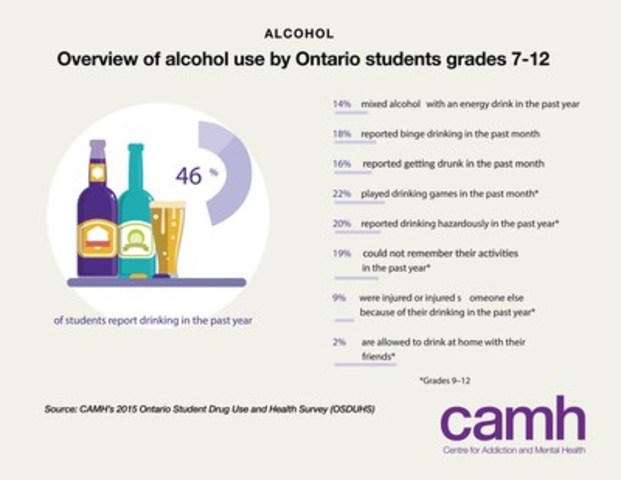
While consumption of alcohol by students has decreased significantly over the last two decades, from 66 per cent in 1999 to 46 per cent in 2015, CAMH researchers remain concerned by the prevalence of alcohol consumption and hazardous drinking behaviour. As many as one-in five high school students reported hazardous drinking, a risky pattern of drinking that can cause current or future physical, psychological or social problems. An estimated 18 per cent or 168,100 students reported binge drinking (having five or more drinks on one occasion) at least once in the month before taking the survey. Alcohol is also perceived as the most readily available drug, with 65 per cent of all students reporting it as "fairly easy" or "very easy" to get.
"Rates of student drinking have declined over the long term, but are still very high and have recently levelled off," said Dr. Robert Mann senior scientist at CAMH and co-lead investigator of the OSDUHS. "Binge drinking is dangerous, and we are concerned to see nearly 20 per cent of high-schoolers report blacking out on at least one occasion in the last year."
New to the survey this year, high school students were asked if their parents allowed them to drink at home. More than one-quarter (27 per cent) of both males and females reported that they were allowed to drink at home with friends. "We were surprised by this number," said Dr. Mann. "It suggests some parents might think it's safer to supervise kids while they drink. In fact, other research shows that students who are allowed to drink at home are more likely to drink excessively."
Males and females equally likely to use cannabis
Cannabis is also high on the list of drugs used in the past year. One-in-five students in grades 7 to 12, an estimated 203,900 Ontario kids, report using cannabis in the past year, with males and females being equally likely to use the drug. Use increases with grade level, with 37 per cent of grade 12 students reporting having used cannabis in the past year.
With increasing availability of electronic smoking devices, CAMH researchers included a new question, asking students whether they used e-cigarettes to smoke or "vape" cannabis oil, liquid, or wax. Responses showed that about five per cent of high school students, an estimated 35,300, reported vaping cannabis in the past year.
"Vaping seems to be emerging as an alternative way to consume cannabis," said Dr. Hayley Hamilton, CAMH scientist and co-lead investigator of the OSDUHS. "It's important for us to try to get a sense of how these devices are being used by young people before the behavior becomes widespread."
E-cigarette use surpasses regular cigarettes
Survey results also showed that in 2015 more students used electronic cigarettes than tobacco cigarettes. Nine per cent of students in grades 7 to 12 said they smoked regular cigarettes during the past year, while 12 per cent, an estimated 107,800 individuals, said they had more than a few puffs of an electronic cigarette, with or without nicotine.
"These numbers could mean that students are assuming it is safer to use e-cigarettes than tobacco cigarettes," said Dr. Hamilton. "But the problem is we still don't know how safe e-cigarettes are. Research on the effects of e-cigarettes is in very early stages and we don't know about longer-term health and safety effects."
Prescription opioid use drops, ecstasy use increases
Among students surveyed, non-medical use of prescription opioids has dropped significantly from 21 per cent in 2007, the first year of monitoring, to 10 per cent in 2015. "While this trend is certainly positive, 10 per cent of students using highly addictive prescription opioids for non-medical reasons is still far too high," said Dr. Mann.
For students in grades 9 to 12, past year use of ecstasy increased from three per cent in 2013 to more than 5 per cent in 2015, with a greater increase among females than males. "It's hard to pinpoint why we are seeing this recent increase among females, but it is something to be closely monitored," Dr. Mann says.
Regional differences
Researchers also observed a number of regional differences in past year drug use. Students in Northern Ontario use alcohol (52%), tobacco cigarettes (12%), and report binge drinking (22%) at rates above the provincial average. Students in Eastern Ontario use tobacco cigarettes (11%) and also e-cigarettes (17%) at rates above the provincial average. Students in Toronto use inhalants (4%) such as glue and solvents at rates above the provincial average. A detailed breakdown of drug use by Local Health Integration Networks (LHINs) is available on camh.ca.
The Centre for Addiction and Mental Health (CAMH) is Canada's largest mental health and addiction teaching hospital and a world leading research centre in this field. CAMH combines clinical care, research, education, policy development and health promotion to help transform the lives of people affected by mental illness and addiction. CAMH is fully affiliated with the University of Toronto, and is a Pan American Health Organization/World Health Organization Collaborating Centre. For more information, please visit camh.ca or follow @CAMHnews on Twitter.
OSDUHS is Canada's longest-running systematic study of alcohol and other drug use among youth, and one of the longest-running surveys in the world. During the 2014-15 school year, 10,426 students from across Ontario in grades 7 to 12 participated in the survey, administered on behalf of CAMH by the Institute for Social Research at York University.
SOURCE Centre for Addiction and Mental Health
Image with caption: "Overview of alcohol use by Ontario students grades 7 - 12. CAMH's Ontario Student Drug Use and Health Survey (OSDUHS) is Canada's longest-running systematic study of alcohol and other drug use among youth, and one of the longest-running surveys in the world. (CNW Group/Centre for Addiction and Mental Health)". Image available at: http://photos.newswire.ca/images/download/20151209_C3691_PHOTO_EN_561032.jpg
For further information: Media Contact: Kate Richards, Media Relations, Centre for Addiction and Mental Health (CAMH), (416) 595-6015, media@camh.ca