


Nursing Leadership
Building Leadership in Home Health Nursing Practice in Canada: Updating the Home Health Nursing Competencies
Abstract
Home health nursing in Canada is evolving to meet the growing demand for community-based care, driven by an aging population and pressures shifting care from acute settings to home. This commentary describes the collaboration between the Community Health Nurses of Canada and Saint Elizabeth Health Care to revise the 2010 Home Health Nursing Competencies through two distinct work streams. A comprehensive Dissemination Resource Package was designed to support the integration of updated competencies into practice. Ongoing engagement of nursing leaders and organizations is essential to ensure that these competencies remain relevant and effective in improving care quality in home health settings.
Introduction
Home health nursing in Canada is evolving to meet the diverse and changing needs of the Canadian population (Lefebre et al. 2024). The aging demographic (Lee et al. 2024) and systemic pressures to transition care from acute to community-based environments are significantly increasing the demand for home care services (Ganann et al. 2019; Stajduhar et al. 2023). Despite their advancing complexity and critical role, the contributions of home health nurses have become increasingly invisible, with their responsibilities often misunderstood and poorly represented within health systems (Sanders 2023). The Community Health Nurses of Canada (CHNC), a voluntary national association for community health nurses, is dedicated to enhancing the visibility and strengthening the role of home health nursing in Canada as part of CHNC's larger mandate to advance community health nursing (CHN) practice, ultimately supporting the improvement of health outcomes for people across Canada (CHNC 2019). Home health nurses in Canada have differing levels of educational preparation and licensure, including registered nurses (RNs) who usually hold a bachelor-level degree, registered practical nurses (RPNs) and licensed practical nurses (LPNs) who usually hold a college-level diploma, as well as nurse practitioners (NPs) who are prepared at the graduate level (Ganann et al. 2019; Saari et al. 2025).
As a leader in developing discipline-specific standards, core competencies and certification processes, CHNC enhances the knowledge and skills of community health nurses across the country (Granger et al. 2018). The purpose of this commentary is to describe the leadership journey and engagement strategies used to revise the 2010 Home Health Nursing (HHN) Competencies (CHNC 2024), develop a dissemination resource and share the implications of this collaborative work.
Background
As an essential specialty within the broader practice of CHN, it is vital for home health nurses to identify and maintain specialty-specific competencies to ensure quality of care. Competencies are defined as the key knowledge, skills, and personal attributes required for safe and ethical home health nursing practice (Saari et al. 2025). It is important to distinguish competencies from role or activity descriptions. While roles and activities describe specific tasks or functions that a home health nurse may perform, competencies represent higher-level statements that integrate knowledge, skills and judgement across multiple roles and activities (Mrayyan et al. 2023). For example, a single competency may encompass a variety of roles and activities, reflecting the broader capabilities required for effective practice rather than focusing on individual tasks alone. This distinction highlights the importance of competencies in guiding professional development as they allow for self-assessment of nursing practice within complex and evolving care environments. These discipline-specific HHN competencies outline the essential attributes a home health nurse needs to provide safe and ethical care (Mrayyan et al. 2023).
In 2010, the CHNC had endorsed a set of home health nursing-specific competencies covering key nursing activities (CHNC 2024). These competencies are defined as the “integrated knowledge, skills, judgment, and attributes required of a home health nurse working in home health to practice safely and ethically” (CHNC 2024: 6). However, due to significant changes in the Canadian healthcare system since 2010, there was an urgency to update these competencies to better reflect the complexity and diversity of current home health nursing practice. For example, the 2010 HHN Competencies did not incorporate important national healthcare reforms such as the Truth and Reconciliation Commission of Canada Calls to Action and legislative changes related to Medical Assistance in Dying, nor did they consider Indigenous ways of knowing or the importance of providing integrated and person-centred home care (Saari et al. 2025). Home health nurses provide essential support for older adults living with frailty, individuals with complex, chronic, disabling conditions and those at the end of life (Canadian Home Care Association 2016). The role of home health nurses varies across Canada, depending on the provincial and territorial health systems (Johnson et al. 2017). As provinces integrate diverse care models, including virtual care and remote monitoring, a skilled and competent home health nursing workforce is paramount (Ganann et al. 2019). Home health nurses must possess a broad skill set that includes clinical competencies and skills in psychological safety, case management, client education and behavioural management (McCrory 2018).
Home health nurses operate independently, leveraging various technologies and collaborating with interprofessional teams to provide comprehensive care (Melby et al. 2018). As expert generalists, they require robust organizational and leadership support to enhance their skills and improve client experiences. Community Health Nurse Educators in Canada have expressed serious concerns about the declining focus on CHN, including home health nursing, in nursing curricula (Sanders et al. 2024). Many academic nursing programs are continuously prioritizing acute care skills, which results in limited exposure for students to community-oriented practices (Sanders et al. 2024). This shift threatens to leave future nurses underprepared for home healthcare because they lack essential competencies in case management, patient education and technology utilization. As the demand for home health services continues to rise, it is crucial that home health nurses must have access to evidence-based competencies to guide their care. The health and safety of clients are directly influenced by the skills and competence of their care providers (Fukada 2018).
Shared Vision to Update the Home Health Nursing Competencies
In the spring of 2023, informal discussions began between CHNC and Saint Elizabeth Health Care (SE Health). It became clear that SE Health shared CHNC's concerns regarding the outdated competencies and limited research in home health nursing. This mutual interest prompted further exploration into revising the competencies. In the fall of 2023, CHNC and SE Health signed a memorandum of understanding to collaborate on this shared priority to review and update the 2010 HHN Competencies. The goal of the updated competencies was to meet the evolving needs of Canadian community health nurses working in the unique environment of home and community care. Specifically, the competencies were intended to equip home health nursing leaders and point-of-care home health nurses with the evidence necessary to guide and support their work with purpose and positively contribute to the health and social care of everyone in Canada. Consistent with Donner's (2017) recommendations, this collaborative partnership aimed to enhance the role and visibility of home health nursing in Canada through effective engagement strategies and leadership initiatives.
Project Scope and Management
The project scope was focused on defining specialty competencies specific to the direct care provided by home health nurses (RNs and RPNs/LPNs) in Canada. NPs were not included in the scope of the project, nor were the competencies of home health nursing leaders. A comprehensive project charter, along with an ambitious timeline with clear activities and deliverables with two distinct workstreams, was established: a project workstream and a research workstream.
The project workstream, led by SE Health Project Lead Cheryl Reid-Haughian and the CHNC President Karen Curry, focused on engaging diverse voices from the home health nursing community across Canada. To facilitate the involvement of CHNC members and other interested parties in revising and disseminating the revised 2024 HHN Competencies, CHNC formed a Steering Committee (SC) under this workstream. The co-chairs of the project workstream, along with six other CHNC members with expertise in various home health nursing practice domains, such as point-of-care, education, policy and research, met regularly to ensure adherence to project timelines and provide guidance on logistics, communications and dissemination. In addition, a broader Advisory Work Group (AWG) was established. This AWG offered regional input on project activities and deliverables, ensuring that the final competencies are nationally representative and aligned with the 2019 CHNC Standards (CHNC 2019). The AWG was designed with the intention to ensure that the workgroup reflected diversity in people, geographic area and home health nursing position; this included balancing practical experience, academic knowledge and “on-the-ground” nursing perspective. Using CHNC's established networks, the project workstream contacted home health nurses and their organizations. Despite competing demands and a health human resource shortage, 20 nurses from direct practice, education, research and leadership responded, within a month, to join the project, speaking to the importance of this work.
The research workstream, led by Margaret Saari from the SE Research Centre, designed the research approach. A formal, evidence-informed eDelphi (consensus-building) process was conducted to update the HHN competencies, considering current research and the Canadian home and community care context. Full research results from the eDelphi have been reported elsewhere (Saari et al. 2025). Below is a summary of the research findings.
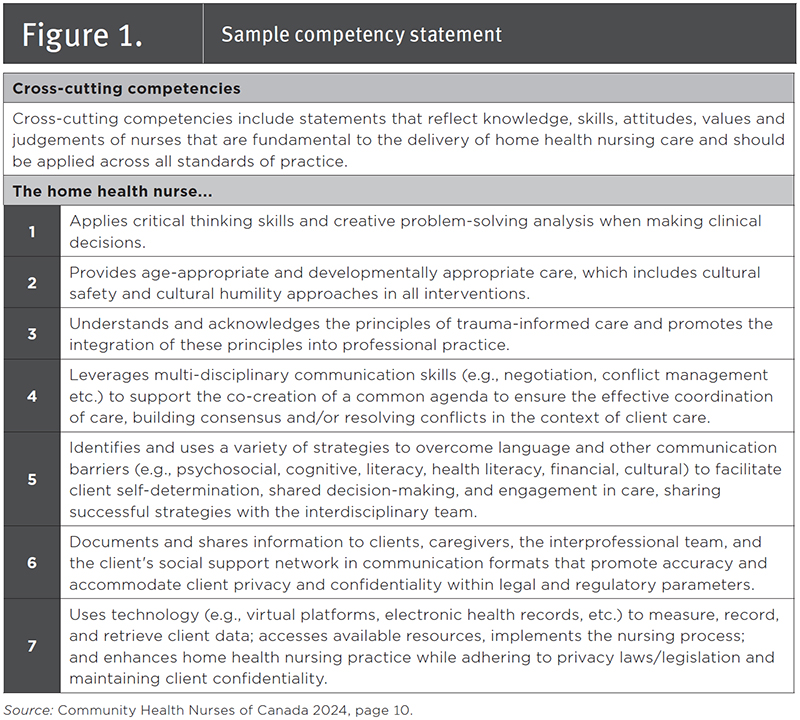
A four-phase modified eDelphi study was conducted, beginning with an environmental scan that identified 359 competencies, which were consolidated into 96 statements and used in a three-round eDelphi with home health nurses across Canada (n = 43). Validation of the draft competencies was completed via two consultations held between April and May 2024 through an in-person preconference workshop session and an online survey with interdisciplinary home care team members. Participants reviewed the draft competencies to provide feedback on their relevance, clarity and completeness, ensuring alignment with interdisciplinary perspectives and current home care practice. Ultimately, 79 competencies were identified as relevant and essential for current home health nursing practice, with qualitative feedback informing clarity and implementation considerations (see Figure 1 for an example of a competency statement).
Project Timelines
CHNC and SE Health recognized the need to complete this project within a year to leverage an upcoming CHNC conference in April 2024. The conference target date served as a motivating force for the project team, ensuring a continuous focus on achieving key project deliverables as outlined in Figure 2.
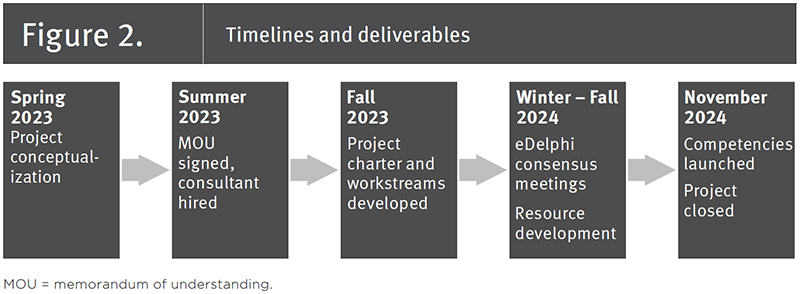
In spring 2023, what began as a simple conversation over coffee between CHNC and SE Health quickly evolved into the confirmation of a shared vision. By summer 2023, that vision was formalized through the signing of a project memorandum of understanding, alongside SE Health's hiring of a consultant to help guide the work forward. Momentum continued into fall 2023, when the project charter was established, key workstreams and memberships were identified and clear deliverables were outlined for both the project and research teams. During this time, an SC was created, and the research team began its foundational work. In winter 2024, an AWG was formed, and eDelphi consensus meetings were conducted, strengthening collaboration and refining direction. In spring 2024, efforts shifted toward preparing for the CHNC pre-conference workshop, accompanied by dissemination activities and feedback loop consultations. Following the pre-conference workshop, the team designed a comprehensive dissemination resource, drafted feedback recommendations to CHNC and began developing a leadership article. By fall 2024, both the dissemination resource and articles from the project and research teams were finalized. The project was completed in November 2024 with the launch of the new 2024 HHN Competencies and Dissemination Resource Package, marking a successful hand-off to CHNC and the formal conclusion of the project.
Pre-Conference Workshop
On April 22, 2024, the project SC hosted an in-person one-day free pre-conference workshop in Toronto, Canada. A structured approach to the pre-conference workshop served as a platform for gathering broader input and feedback. There were 41 nurses from across the country and from different levels of practice who attended the workshop. The SC worked with the CHNC conference planning team to share information about the free consultation session that would be available at the pre-conference workshop. The pre-conference served two aims. The morning session focused on providing participants with information about the revision of the 2010 HHN Competencies (CHNC 2024). The SE Research team presented their findings from the eDelphi consensus study and validated the final competency statements with the pre-conference participants. The afternoon session provided the SC team time to collect input on tools, resources and processes that would support dissemination and ongoing feedback mechanisms. The SC aimed to hear the voices of front-line home health nurses, encouraging them to share their ideas and strategies for collectively promoting the use and application of Health Nursing Competencies. Participants were invited to answer three key questions: (1) What potential challenges might arise in disseminating the HHN Competencies? (2) What opportunities exist for effectively disseminating the HHN Competencies? (3) How can CHNC best obtain ongoing feedback from home health nurses across Canada regarding the continued relevance of the HHN Competencies? The workshop fostered collegial discussions about tools and strategies to support the uptake and sharing of these competencies and served as an important engagement strategy that provided significant breadth and depth of feedback.
The SC identified several key messages from the pre-conference workshop participants:
- Practice support and implementation: Home health nurses and their organizations clearly identified the need for practice support tools and implementation suggestions, not just a new set of competencies. Organizations need resources to support their effort in implementing practice change.
- Clarity of language: Participants suggested that the language of the competencies should be simple and clear so they can be easily interpreted and integrated into practice. Competency statements must be understandable and applicable across the diverse landscape of home health nursing.
- Further education and awareness: Participants indicated that they would like more education on some concepts included in the competency set and that a glossary of terms should be included in the final set of competencies. Home health nurses verbalized some knowledge gaps and shared their perspective on how home health nurses demonstrated these concepts in practice.
- Feedback loops: Participants requested that CHNC develop mechanisms to ensure that the competencies remain current and reflective of home health nursing practice as it evolves. For example, organizations need to consider building feedback loops and communication plans to evaluate and support the use of competencies or standards of practice, and associations need to consider their role in creating feedback loops at a national level.
Outcomes From Pre-Conference Workshop
Feedback from pre-conference participants offered valuable, concrete actions to guide the SC in completing their work throughout the summer and fall of 2024. A structured dissemination plan and development of tools to support knowledge transfer were included in the SC work. With many hours of work, outside the regular project meeting, a comprehensive Dissemination Resource Package was created for release in November 2024. This resource package is intended to support the use of the competencies at the individual level, as well as their adoption and implementation within organizations (see Table 1). The Dissemination Resource Package is available for download from the CHNC website.
| Table 1. Contents of Dissemination Resource Package | |
| Item | Description/purpose |
| Competency statements with practice interpretation | A detailed list of Canadian HHN competency statements, including practical interpretation and application guidance to support accessible and meaningful understanding of the revised competencies. |
| Infographic | A one-page, high-level visual snapshot of the revised competencies is designed to educate both leaders and home health nurses. |
| Slide deck presentations | Educational slide decks explaining the changes and impact of the revised competencies. Separate versions were made for point-of-care home health nurses and home health nursing leaders. |
| Communication calendar and key messages | A structured communication plan with key messages to support the dissemination and implementation of the 2024 HHN Competencies. |
| Self-assessment guides | Tools designed to help home health nurses conduct a personal self-assessment of their current competencies. |
| HHN = Home Health Nursing. | |
CHNC will continue to support the sharing of the HHN Competencies and activities as part of the overall CHNC strategic workplan. CHNC will facilitate feedback on the use of the competencies in organizations and work with home health nurses to build upon the dissemination resource package to create more resources for implementation and evaluation. This project demonstrated that tight timelines, combined with the development of a meaningful engagement strategy and product creation, are achievable with a strong project plan and dedicated resources.
Lessons Learned
This project offers several valuable lessons for nursing leaders to use in future collaborations. Initially, three key leadership challenges were identified as barriers to successfully moving this project forward: funding, human health resources and timelines.
- Funding: CHNC recognized that it did not have the funding or expertise to conduct this project on its own. For this reason, establishing a collaborative partnership was needed in order to carry out the 2024 HHN Competencies revision work. SE Health provided the required funding to support the research workstream team and the position of project lead for the project workstream. This allowed for strong research expertise from the SE Health Research Centre and strong project expertise from an experienced home health nursing consultant.
- Human health resources: The project co-leads (CHNC President and SE Health Project Lead) worked to ensure that the right process and structures were in place to guide the project. Key structures for success included the formation of both an SC and AWG to ensure that all project activities and deliverables were achievable. With two distinct workstreams (research and project) driving the project charter, the leadership and project oversight provided by the project consultant, who supported project activities and coordinated communication with the research team, proved to be a valuable leadership strategy.
- Timelines: Although the timeline was ambitious, CHNC's partnership with SE Health brought in valuable research expertise and an experienced home health nursing consultant to lead the project, making the seemingly impossible attainable. The project team is grateful for the engagement and dedication of home health nurses from coast to coast to coast who provided input for this work. We acknowledge that effective collaboration between research and practice in home health demands time and a dedicated team to meet project and research deadlines.
Implications for Nursing Leadership
The competencies strengthen leadership within practice by clearly articulating the scope, depth and complexity of home health nursing. The role of home health nurses is often not well differentiated from other community-based providers (Sanders 2023), and as integrated models of care continue to evolve, the competencies serve as an ongoing reminder of the distinct and essential contributions of home health nurses within interdisciplinary teams. This role clarity supports improved collaboration and enhances recognition of home health nursing expertise.
At the policy level, the competencies have important implications for accreditation and service excellence standards within home healthcare. Specifically, they may inform the development or refinement of accreditation criteria aligned with home health nursing service excellence standards. Embedding the competencies within accreditation frameworks would promote consistency, accountability and quality across organizations delivering home-based services.
There are also implications to enhance a stronger alignment between HHN Competencies and nursing education curricula. It is recommended that curriculum design in nursing education explicitly incorporate HHN competencies to better prepare graduates for current community-based practice (Saari et al. 2025). This recommendation is particularly timely given the documented erosion of CHN theory within nursing curricula (Sanders et al. 2024).
Finally, the updated competencies also have implications for research and workforce stabilization. There remains a notable dearth of Canadian home health nursing research. The competencies can guide future Canadian research agendas, including competency implementation and equity in home-based care. In addition, the 2024 HHN Competencies can be used to support workforce stabilization and staff retention initiatives by aligning the knowledge, skills and judgement of home health nurses with their day-to-day practice demands (Saari et al. 2025).
Future Steps
The implementation and integration of the new 2024 HHN Competencies is now entrusted to the individual home health nurses and their organizations. Home health nursing leaders will face two key challenges: (1) engaging organizational leadership to prioritize competency integration and (2) finding time to implement the new competencies in an overstretched health system. CHNC will continue to develop meaningful feedback mechanisms to ensure that the competencies remain current and relevant; advocate for greater recognition of the HHN competencies; and evaluate the effectiveness of the updated competencies and dissemination resources to ensure sustainability.
Conclusion
The HHN Competencies project was a labor of love for home health nursing leaders. The collaboration between a professional nursing association and a home health service provider organization offered a unique way to develop new research and build practice and nursing association connections. Still, this project highlights the need to strengthen home health nursing content in academic curricula to enhance CHN education. The lessons learned from this collaboration will help shape future CHNC initiatives. Magic is possible with strong connections, great collaboration and shared goals.
Statement of Financial or Other Relationships That Might Lead to a Conflict, or Perceived Conflict, of Interest
Cheryl Reid-Haughian received funding from SE Health as the project lead for the Canadian Home Health Nursing Competencies Project. There are no other financial disclosures or conflicts of interest.
Authorship Criteria
We confirm that all authors listed meet the three authorship criteria of the International Committee of Medical Journal Editors (Defining the Role of Authors and Contributors).
AI Statement
We confirm that we did not use any AI technology in the development of the manuscript.
Correspondence may be directed to Barbara Chyzzy by e-mail at barbara.chyzzy@torontomu.ca.
About the Author(s)
Karen Curry,* RN, MN, CCHN(C), President, Community Health Nurses of Canada, Assistant Professor, School of Nursing, Dalhousie University, Halifax, NS
Cheryl Reid-Haughian,* RN, MHScN, CCHN(C), Home and Community Consultant, Cheryl Reid-Haughian Consulting, Ottawa, ON
Barbara Chyzzy,* RN, Phd, CCHN(C), President-Elect, Community Health Nurses of Canada, Assistant Professor, Daphne Cockwell School of Nursing, Toronto Metropolitan University, Toronto, ON
Leinic Chung-Lee, RN, MN, Phd, Incoming Chair, Standards and Competencies Committee, Community Health Nurses of Canada, Affiliated Researcher, Bridging Divides Research Program, Daphne Cockwell School of Nursing, Toronto Metropolitan University, Toronto, ON
Benedicte Franquien, RN, BN, MScN (c), Digital Health Practice Lead & Professional Practice and Quality Consultant, VON Canada, Halifax, NS
Nancy Lefebre, RN, BScN, MN, Chief Operating Officer, Chief Clinical Executive and Senior Vice President, SE Health, Markham, ON
Jennifer Little, RN, MN, Treasurer, Community Health Nurses of Canada, Home Health Nurse, SE Health, Toronto, ON
Corey MacKenzie, RN, MN, Senior Director, SE Health, Halifax, NS
Margaret Saari, RN, Phd, Senior Research Scientist, SE Health, Markham, ON
* Co-first author.
References
Canadian Home Care Association. 2016, October. Better Home Care in Canada: A National Action Plan. Retrieved October 23, 2024. <https://cdnhomecare.ca/wp-content/uploads/2020/03/Better-Home-Care-Report-web-EN.pdf>.
Community Health Nurses of Canada (CHNC). 2019, January. Canadian Community Health Nursing Professional Practice Model & Standards of Practice. Retrieved April 17, 2026. <https://www.chnc.ca/wp-content/uploads/2026/01/canadian-community-health-nursing-professional-practice-model-standards-of-practice.pdf>.
Community Health Nurses of Canada (CHNC). 2024, November. Canadian Home Health Nursing Competencies. Retrieved April 17, 2026. <https://www.chnc.ca/wp-content/uploads/2025/12/cdn-home-health-nrsg-competencies-2024.pdf>.
Donner, G. 2017. Nursing Leadership in Home and Community Care: An Introduction. Canadian Journal of Nursing Leadership 30(1): 6–10. doi:10.12927/cjnl.2017.25111.
Fukada, M. 2018. Nursing Competency: Definition, Structure and Development. Yonago Acta Medica 61(1): 1–7. doi:10.33160/yam.2018.03.001.
Ganann, R., A. Weeres, A. Lam, H. Chung and R. Valaitis. 2019. Optimization of Home Care Nurses in Canada: A Scoping Review. Health and Social Care in the Community 27(5): e604–21. doi:10.1111/hsc.12797.
Granger, M., R. Schofield, J. Fox, K.E. Dilworth, N. Whyte, K. Thompson et al. 2018. Three Decades of Professional Nursing Leadership: The Impact of the Community Health Nurses of Canada. Canadian Journal of Nursing Leadership 31(4): 63–73. doi:10.12927/cjnl.2019.25754.
Johnson, C.S., J. Bacsu, T. McIntosh, B. Jeffery and N. Novik. 2017, October. Home Care in Canada: An Environmental Scan. Saskatchewan Population Health and Evaluation Research Unit, University of Regina and University of Saskatchewan. Retrieved October 22, 2024. <https://spheru.ca/publications/files/HomeCare_complexCare_environmental%20Scan18Oct2017.pdf>.
Lee, J., J.A. Watt, A. Mayhew, C.-L. Sinn, C.L. Schumacher, A.P. Costa et al. 2024. Equity in Home Care Use in Canada: A Cross-Sectional Analysis of the Canadian Longitudinal Study on Ageing. BMJ Public Health 2(2): e000812. doi:10.1136/bmjph-2023-000812.
Lefebre, N., C. McPherson, M. Monkman and J. Brooke. 2024. Home Health Nursing in Canada. In L.L. Stamler, L. Yiu, A. Dosani, J. Etowa and C. Van Daalen-Smith, eds., Community Health Nursing: A Canadian Perspective (6th ed.): 99-122. Pearson Prentice Hall.
McCrory, V. 2018. An Overview of the Role of the District Nurse Caring for Individuals With Complex Needs. British Journal of Community Nursing 24(1): 20–26. doi:10.12968/bjcn.2019.24.1.20.
Melby, L., A. Obstfelder and R. Hellesø. 2018. “We Tie Up the Loose Ends”: Homecare Nursing in a Changing Health Care Landscape. Global Qualitative Nursing Research 5. doi:10.1177/2333393618816780.
Mrayyan, M.T., H.Y. Abunab, A.A. Khait, M.J. Rababa, S. Al-Rawashdeh, A. Abdullah et al. 2023. Competency in Nursing Practice: A Concept Analysis. BMJ Open 13(6): e067352. doi:10.1136/bmjopen-2022-067352.
Saari, M., C. Coumoundouros, J. Tadeo, B. Chyzzy, M. Northwood and J. Giosa. 2025. Advancing Home Health Nursing Competencies in Canada to Reflect a Dynamic Care Environment and Complex Population Health Needs: A Modified eDelphi Study. BMC Nursing 24(1): 378. doi:10.1186/s12912-025-03045-5.
Sanders, T. 2023. The Social Relations of Home Care Nursing Work. Phd Dissertation. Retrieved October 22. <https://dspace.library.uvic.ca/items/9fea1b39-5c6c-466b-bde6-16d995c630a7>.
Sanders, T., J. Avanthay Strus, B. Chyzzy, A. Chircop, G. Currie, F. Fillion et al. 2024. Understanding the Current State of Community Health Nursing Education in Canada: An Exploration of the Erosion and Devaluation of Community Health Theoretical and Practice Education in Canadian Nursing Programs. Quality Advancement in Nursing Education 10(3): 2. doi:10.17483/2368-6669.1447.
Stajduhar, K., R. Sawatzky, L. Funk, S.R. Cohen, A. Bitschy, E. Donald et al. 2023. Shifts in Homecare Nursing Practices and Their Implications for Families and Clients Receiving Palliative Care at Home. Canadian Journal of Nursing Leadership 36(1): 75–86. doi:10.12927/cjnl.2023.27122.
Comments
Be the first to comment on this!
This article is for subscribers only. To view the entire article
Related Articles


Note: Please enter a display name. Your email address will not be publically displayed