


Healthcare Quarterly
High and Repeated Hospital and Emergency Department Use for Mental Health and Substance Use in Canada
Allie Chen, Pardis Noormohammadpour, Alexey Dudevich, Babita Gupta, Derek Lefebvre and Cheryl Chui
Abstract
Individuals with mental health and substance use (MHSU) conditions account for a disproportionate share of hospital and emergency department (ED) service use in Canada. This analysis draws on three Canadian Institute for Health Information indicators: 30-day readmissions, repeat hospitalizations and frequent ED visits for help with MHSU. Results show that rates across all indicators remained persistently elevated and, in 2024–2025, were approximately 8–9% higher than those in pre-pandemic baseline years. Higher rates are consistently observed among individuals living in lower-income neighbourhoods, adults aged 25–44 years and those with substance use-related conditions. Taken together, these indicator results point to recurring patterns of acute care use that reflect gaps in continuity, access to community-based care and integration across services. Strengthening transitions of care, expanding community-based supports and improving integration for individuals with complex and co-occurring conditions are critical to reducing avoidable acute care use.
Introduction
Mental health and substance use (MHSU) conditions are a leading contributor to morbidity and health system use in Canada and place sustained pressure on hospitals, emergency departments (EDs) and community-based services. A relatively small proportion of patients account for a disproportionate share of acute care use and system costs (de Oliveira et al. 2018; Wodchis et al. 2016).
Repeated reliance on hospital and ED settings often signals unmet need, gaps in continuity of care and limited access to timely community-based services (Moe et al. 2022). For individuals, these patterns often represent cycles of crisis and stabilization without sustained recovery; for health systems, they point to challenges in delivering coordinated, person-centred care.
To better understand these patterns, the Canadian Institute for Health Information (CIHI) reports three indicators that each capture different but related dimensions of repeated acute care use:
- 30-day readmission for MHSU,
- repeat hospital stays for MHSU (three or more per year), and
- frequent emergency room visits for help with MHSU (four or more visits per year).
Examined together, these indicators offer complementary perspectives on high and repeat acute care use across hospital and ED services in Canada. While the indicators capture overlapping but not identical patient populations, together they help to identify system-level patterns associated with recurring acute care use.
Methods
All three indicators were calculated using CIHI's administrative datasets, including the Discharge Abstract Database, Hospital Morbidity Database, National Ambulatory Care Reporting System and Ontario Mental Health Reporting System. Detailed methodologies, including limitations, are available in the CIHI Indicator Library (https://www.cihi.ca/en/access-data-and-reports/indicator-library). The indicators are reported separately and are not linked longitudinally at the patient level; therefore, findings should be interpreted as complementary system-level measures rather than a single patient trajectory.
Indicators are stratified by neighbourhood income quintile, age group, sex or gender and urban versus rural or remote residence. Risk adjustment incorporates demographic and clinical covariates, including age group, sex or gender, mental health category and discharge against medical advice, along with indicator-specific covariates.
Sustained elevation in repeated acute care use
In 2024–2025, repeated acute care use for MHSU remained high across all indicators, with national rates of 13.1% for 30-day readmissions, 12.8% for repeat hospitalizations and 10.2% for frequent ED visits.
Across available years of data, rates for all three indicators generally increased year over year before to the COVID-19 pandemic, rose further during the pandemic and declined modestly afterward, but remained above pre-pandemic levels (Figure 1), suggesting sustained pressure on acute care services. By 2024–2025, risk-adjusted rates were approximately 9.2% higher for readmissions and 7.6% higher for repeat hospitalizations compared with 2015–2016, and 8.5% higher for frequent ED visits compared with 2017–2018.
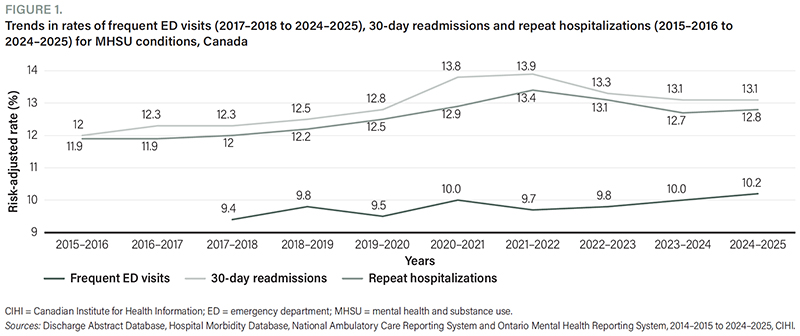
The sustained elevation in rates of acute care use suggests that structural factors, rather than temporary pandemic-related disruptions alone, may be contributing to the ongoing demand for acute MHSU care. This likely includes ongoing gaps in timely access to community-based care and in the coordination of services for individuals with complex needs.
Variation across jurisdictions
Rates for all three indicators varied across jurisdictions. Readmission rates range from approximately 9.5% in Manitoba to above 14% in Ontario and Nunavut, and similar variation was observed for repeat hospitalizations and frequent ED visits (Table 1). Differences across jurisdictions likely reflect a mix of population needs, service availability, workforce capacity, housing challenges and substance use-related harms (Lowe et al. 2024). These factors may contribute to the observed variation in rates but were not directly assessed in this analysis.
| TABLE 1. Rates of 30-day readmissions, repeat hospitalizations and frequent ED visits, by province and territory, Canada, 2024–2025 | |||
| Province/territory | Frequent ED visits | 30-day readmissions | Repeat hospitalizations |
| Canada | 10.2 | 13.1 | 12.8 |
| Newfoundland and Labrador | n/a | 11.9 (10.5–13.4) | 10.6 (9.3–12.2) |
| Prince Edward Island | 9.8 (8.7–11.1)* | 10.5 (8.5–13.0) | 12.7 (10.4–15.4) |
| Nova Scotia | 6.3 (5.4–7.4)* | 10.4 (9.4–11.5) | 10.7 (9.7–11.8) |
| New Brunswick | n/a | 12.3 (11.2–13.5) | 11.6 (10.4–12.8) |
| Quebec | 8.4 (8.2–8.6) | n/a | n/a |
| Ontario | 10.7 (10.5–10.8) | 14.5 (14.2–14.7) | 13.7 (13.4–14.0) |
| Manitoba | n/a | 9.5 (8.8–10.4) | 10.2 (9.4–11.1) |
| Saskatchewan | 11.4 (11.0–11.8)* | 10.6 (9.8–11.4) | 9.9 (9.1–10.7) |
| Alberta | 11.7 (11.5–12.0) | 11.0 (10.6–11.5) | 11.1 (10.7–11.6) |
| British Columbia | 7.9 (7.6–8.2)* | 13.1 (12.7–13.5) | 14.2 (13.8–14.7) |
| Yukon | 18.0 (15.9–20.2) | 13.1 (10.0–17.0) | 17.7 (13.4–23.0) |
| Northwest Territories | n/a | 10.7 (7.7–14.7) | 13.6 (10.5–17.5) |
| Nunavut | n/a | 14.8 (11.9–18.3) | 14.1 (10.9–18.0) |
| Notes: Risk-adjusted rate (per 100). | |||
| *Results are based on partial data and are not comparable due to incomplete record linkage across hospitals. CIHI = Canadian Institute for Health Information; ED = emergency department; n/a = results are not available; n/r = results are not shown due to insufficient data coverage. Sources: Discharge Abstract Database, Hospital Morbidity Database, National Ambulatory Care Reporting System and Ontario Mental Health Reporting System, 2023–2024 to 2024–2025, CIHI. |
|||
Variation by neighbourhood income
Rates across all indicators are consistently higher among individuals living in lower-income neighbourhoods than those in higher-income areas (Figure 2). This gradient suggests that social and structural factors such as access to primary care, housing stability and community supports may contribute to repeated acute care use.
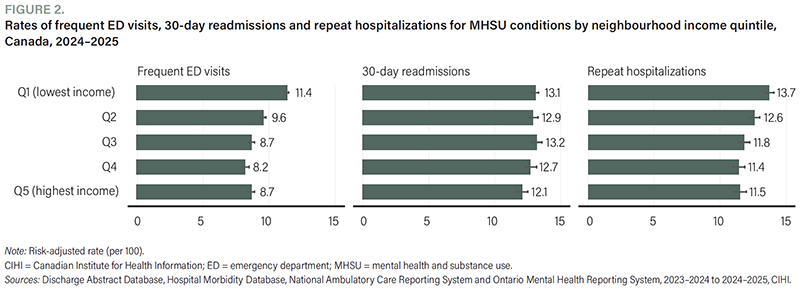
The socio-economic gradient further reinforces the role of broader determinants of health. Higher Q1–Q5 rate ratios for frequent ED visits and repeat hospitalizations than for 30-day readmissions in low-income versus higher-income neighbourhoods may suggest that barriers related to access to community-based care play a larger role than in-hospital processes.
Variation by age and sex
Crude rates show a consistent age pattern across indicators, with rates increasing from childhood to early and mid-adulthood and declining among older adults. The highest rates are observed among individuals aged 25–44. Differences by sex or gender are modest, with slightly higher rates among males than females.
The concentration of repeat use among adults aged 25–44 points to a life stage when MHSU conditions commonly emerge or escalate. At the same time, individuals in this age group may face barriers to accessing timely, community-based treatment and preventive services, potentially increasing reliance on acute care services during periods of crisis.
Clinical complexity and co-occurring conditions
Repeat hospitalization and 30-day readmission rates are highest among individuals with substance use, personality and schizophrenia or other psychotic disorders. For frequent ED visits, approximately half had co-occurring MHSU conditions. This high prevalence of co-occurring conditions highlights the clinical complexity of individuals with repeated acute care use and demonstrates the need for integrated approaches to care.
The presence of concurrent MHSU conditions among frequent users underscores the importance of integrated care models. Individuals with co-occurring conditions require coordinated, multidisciplinary care. When services are fragmented, they may cycle through acute care settings without sustained improvement (Khan 2017; Rush et al. 2008).
Conclusion
High and repeated use of hospital and ED services for MHSU remains a persistent challenge in Canada, with rates still above pre-pandemic levels across all three indicators. Different parts of the problem need different responses. Better discharge planning and timely follow-up may help reduce 30-day readmissions. Coordinated, longitudinal care for individuals with complex and co-occurring MHSU conditions can help reduce repeat hospitalizations. Connecting frequent ED users to ongoing community care and crisis alternatives outside the hospital can help reduce reliance on emergency services.
Because barriers to accessing community-based care may disproportionately affect lower-income neighbourhoods, strengthening primary and mental health care in these areas is likely to bring the biggest improvements. Ultimately, reducing reliance on acute care will depend on building a more integrated, accessible and community-based MHSU system with strong linkages across the continuum of care.
About the Author(s)
Allie Chen, MSc, is a senior analyst at Canadian Institute for Health Information (CIHI) in Toronto, ON.
Pardis Noormohammadpour, MD, MPH, is an analyst at CIHI in Toronto, ON.
Alexey Dudevich, MPA, is a senior analyst at CIHI in Ottawa, ON. Alexey Dudevich can be reached by e-mail at adudevich@cihi.ca.
Babita Gupta, BSc, MBA, is a manager at CIHI in Ottawa, ON.
Derek Lefebvre, BSSc, is a project lead at CIHI in Toronto, ON.
Cheryl Chui, MHSc, MMA, is a director at CIHI in Toronto, ON.
References
de Oliveira, C., J. Cheng, J. Rehm and P. Kurdyak. 2018. The Role of Mental Health and Addiction Among High-Cost Patients: A Population-Based Study. Journal of Medical Economics 21(4): 348–55. doi:10.1080/13696998.2017.1412976.
Khan, S. 2017. Concurrent Mental and Substance Use Disorders in Canada. Health Reports 28(8): 3–8. https://www150.statcan.gc.ca/n1/pub/82-003-x/2017008/article/54853-eng.htm. PMID: 2904444.Lowe, L., D. Fearon, A. Adenwala and D. Wise Harris. 2024. The State of Mental Health in Canada 2024: Mapping the Landscape of Mental Health, Addictions and Substance Use Health. Canadian Mental Health Association. Retrieved May 8, 2026. https://cmha.ca/wp-content/uploads/2024/11/CMHA-State-of-Mental-Health-2024-report.pdf.
Moe, J., E.Y. Wang, M.J. McGregor, M.J. Schull, K. Dong, B.R. Holroyd et al. 2022. People Who Make Frequent Emergency Department Visits Based on Persistence of Frequent Use in Ontario and Alberta: A Retrospective Cohort Study. CMAJ Open, 10(1): E220–31. doi:10.9778/cmajo.20210131.
Rush, B., K. Urbanoski, D. Bassani, S. Castel, T.C. Wild, C. Strike et al. 2008. Prevalence of Co-Occurring Substance Use and Other Mental Disorders in the Canadian Population. Canadian Journal of Psychiatry 53(12): 800–809. doi:10.1177/070674370805301206.
Wodchis, W.P., P.C. Austin and D.A. Henry. 2016. A 3-Year Study of High-Cost Users of Health Care. Canadian Medical Association Journal 188(3): 182–88. doi:10.1503/cmaj.150064.
Comments
Be the first to comment on this!
Personal Subscriber? Sign In
Related Articles


Note: Please enter a display name. Your email address will not be publically displayed