


Healthcare Quarterly
Inside the Pharmaceutical Data Tool’s Numbers: Drivers Behind Canada’s Pharmaceutical Spending
Abstract
Pharmaceutical spending is increasing, and many Canadians are facing challenges with drug affordability. The Pharmaceutical Data Tool (PDT) (CIHI 2026) is a public interactive dashboard launched in 2024 that provides novel insights about drugs that are driving costs. To provide analytical insights on why pharmaceutical spending is increasing, the Canadian Institute for Health Information updated the PDT in January 2026 with 2024 calendar-year data. The PDT provides information on factors that can reduce costs such as biosimilars and formulary coverage. This paper summarizes key findings from the PDT and aims to provide pharmaceutical information users with analytical insights to inform better decision-making.
The Current Pharmaceutical Landscape in Canada
Pharmaceutical spending across Canada accounted for 13.3% of total health expenditures in 2025, with drugs historically being the third largest spending category behind hospitals (26.0%) and physicians (13.8%) (CIHI 2025a). From 2017/2018 to 2022/2023, there has been a compound annual growth rate of 5.9% for total prescription drug expenditure for the public drug plans in Canada (Patented Medicine Prices Review Board 2025), which is outpacing economic growth (CIHI 2025a). Despite increased spending, many Canadians are struggling to afford prescription medications (Health Canada 2019a).
The Pharmaceutical Data Tool (PDT) by the Canadian Institute for Health Information (CIHI) is an interactive dashboard that provides information on public drug program spending and use across Canada (CIHI 2026). CIHI recently updated the PDT with 2024 calendar-year data. The findings from the PDT are designed to make key pharmaceutical information more comprehensive and comparable for stakeholders' analytical and policy needs.
Prescribed Drug Spending in Canada
How did spending change in 2024?
In 2024, total public drug program spending in Canada reached $20.1 billion, and this was a 9.2% increase in spending from 2023 (CIHI 2026).
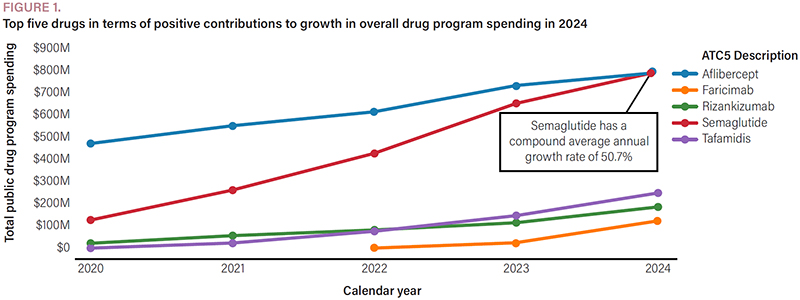
An increase in the prescribing of the drug Ozempic (semaglutide) was the largest contributor to growth in public drug program spending in 2024 (Figure 1) (CIHI 2026). Ozempic is approved for the treatment of type 2 diabetes (Health Canada n.d.a). Spending on Ozempic rose from $662 million in 2023 to $807 million in 2024, which accounted for 8.5% of the total growth in public drug program spending (CIHI 2026). Spending on Ozempic is comparable with aflibercept, which is a drug that is approved for the treatment of retinal eye conditions such as age-related macular degeneration (Health Canada 2024c). Spending on aflibercept rose from $741 million in 2023 to $807 million in 2024, representing 3.9% of total growth in public drug program spending (CIHI 2026).
Savings on generic drugs
Generic drugs are those that have identical medicinal ingredients compared with the brand-name drug and are typically available at a lower cost (Health Canada 2024a).
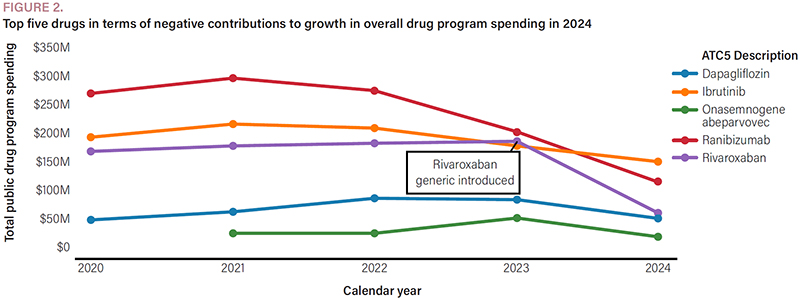
An example of a brand-name drug whose spending decreased after the introduction of a generic version is rivaroxaban in 2023, which is approved to prevent and treat blood clots (Health Canada 2023b). Out of all the top five drugs that had negative contributions to growth in overall drug program spending in 2024 (Figure 2), rivaroxaban had the steepest decline in spending from 2023 to 2024, which was a decrease of $129 million (CIHI 2026).
Spending on high-cost drugs
High-cost drugs are those that have an average cost of $10,000 or more per person in a calendar year, and high-cost individuals are those who had $10,000 or more paid by a public drug program in a calendar year (CIHI 2026). While high-cost individuals made up 3.2% of all beneficiaries, spending on high-cost individuals made up 47% of total public drug program spending in 2024 (CIHI 2026). An example of a high-cost drug is Trikafta (ivacaftor, tezacaftor and elexacaftor), which is approved to treat cystic fibrosis (Health Canada 2024b). Spending on Trikafta increased from $22 million in 2021 to $454 million in 2024 (CIHI 2026).
Spending on biologic and biosimilar drugs
Biologic drugs are those that are derived from living organisms and typically cost more than traditional pharmaceutical drugs (Health Canada 2019b). A biosimilar is structurally similar to a reference biologic, yet it retains the same pharmaceutical properties (Health Canada 2019b). Biosimilar drugs can cost a fraction of the price compared with the reference biologic (Zhang 2025).
Biologic drugs made up 29.7% of total public drug program spending in 2024, which is up from 28.8% in 2023 (CIHI 2026). Biosimilars accounted for 17.7% of spending on all biologics in 2024 compared with 16.1% in 2023 (CIHI 2026). When looking at biologic drugs that have a biosimilar option available, biosimilar spending accounted for more than two-thirds of biologic spending in 2024 (CIHI 2026). The increased spending on biosimilars is largely due to new, less expensive biosimilar options that are becoming available and the introduction of biosimilar switching policies among public drug programs in Canada (Zhang and Peterson 2021).
Drug Use and Spending Among Seniors
Seniors account for 47% of healthcare spending, and this trend is expected to increase (CIHI 2025b). Seniors' higher prevalence of chronic conditions can require the use of multiple drugs (Kwan and Farrell 2013), which increases their risk of falls, emergency department visits and hospitalizations (CIHI 2013). Due to higher drug usage, 88% of seniors had a drug claim through a public drug program (CIHI 2026). The number of seniors taking multiple drugs is also increasing, with 27.1% of seniors having 10 or more drugs prescribed in 2024, which is up from 26.2% of seniors in 2023 (CIHI 2026).
Benzodiazepines are drugs that are prescribed to help treat insomnia and anxiety; however, there are risks associated with their use, especially for seniors (Health Canada 2023a). About 10.1% of seniors were prescribed these drugs in 2024 compared with 12.6% in 2020, resulting in a 2.5% decrease (CIHI 2026). This could be due to the awareness of risks and guidelines that recommend caution when prescribing benzodiazepines to seniors (Davies et al. 2018).
Next Steps With the PDT
Future expansions to the PDT will include further data insights as well as updated pharmaceutical claims data. This ensures that pharmaceutical information users have more comprehensive and comparable data for analytical and policy needs.
Additional Resources
Pharmaceutical Data Tool: https://www.cihi.ca/en/pharmaceutical-data-tool
National Prescription Drug Utilization Information System: National Prescription Drug Utilization Information System metadata | CIHI
About the Author(s)
Shveta Bhasker, MHI, is a senior analyst in the Health Spending, Pharmaceuticals branch at the Canadian Institute for Health Information (CIHI) in Toronto, ON. Shveta Bhasker can be reached by e-mail at sbhasker@cihi.ca.
Sandy Morrison, MSc, is a senior analyst in the Health Spending, Pharmaceuticals branch at CIHI in Ottawa, ON. Sandy Morrison can be reached by e-mail at smorrison@cihi.ca.
Jeff Proulx, BSc, is a program lead in the Health Spending, Pharmaceuticals branch at CIHI in Ottawa, ON. Jeff Proulx can be reached by e-mail at jproulx@cihi.ca.
References
Canadian Institute for Health Information (CIHI). 2013, March. Adverse Drug Reaction–Related Hospitalizations Among Seniors, 2006 to 2011. Retrieved April 21, 2026. <https://publications.gc.ca/collections/collection_2013/icis-cihi/H117-5-25-2013-eng.pdf>.
Canadian Institute for Health Information (CIHI). 2025a, November 27. NHEX Trends – Infographics. Retrieved April 21, 2026. <https://www.cihi.ca/en/national-health-expenditure-trends/nhex-trends-infographics>.
Canadian Institute for Health Information (CIHI). 2025b, November 27. NHEX Trends, 2025 – Snapshot. Retrieved April 21, 2026. <https://www.cihi.ca/en/national-health-expenditure-trends/nhex-trends-reports/nhex-trends-2025-snapshot>.
Canadian Institute for Health Information (CIHI). 2026, January 22. Pharmaceutical Data Tool. Retrieved April 21, 2026. <https://www.cihi.ca/en/pharmaceutical-data-tool>.
Davies, S.J.C., B. Jacob, D. Rudoler, J. Zaheer, C. de Oliveira and P. Kurdyak. 2018. Benzodiazepine Prescription in Ontario Residents Aged 65 and Over: A Population-Based Study From 1998 to 2013. Therapeutic Advances in Psychopharmacology 8(3): 99–114. doi: 10.1177/2045125317743651.
Health Canada. 2019a, June. A Prescription for Canada: Achieving Pharmacare for All. Government of Canada. Retrieved April 21, 2026. <https://www.canada.ca/content/dam/hc-sc/images/corporate/about-health-canada/public-engagement/external-advisory-bodies/implementation-national-pharmacare/final-report/final-report.pdf>.
Health Canada. 2019b, August 23. Biosimilar Biologic Drugs in Canada: Fact Sheet. Government of Canada. Retrieved April 21, 2026. <https://www.canada.ca/content/dam/hc-sc/migration/hc-sc/dhp-mps/alt_formats/pdf/brgtherap/applic-demande/guides/Fact-Sheet-EN-2019-08-23.pdf>.
Health Canada. 2023a, February 8. Benzodiazepines. Government of Canada. Retrieved April 21, 2026. <https://www.canada.ca/en/health-canada/services/substance-use/controlled-illegal-drugs/benzodiazepines.html>.
Health Canada. 2023b, November 8. Details for: RIVAROXABAN. Retrieved April 21, 2026. <https://dhpp.hpfb-dgpsa.ca/dhpp/resource/103014>.
Health Canada. 2024a, May 7. Access to Generic Drugs in Canada. Retrieved April 21, 2026. <https://www.canada.ca/en/health-canada/services/drugs-health-products/drug-products/fact-sheets/access-to-generic-drugs.html#a1>.
Health Canada. 2024b, August 14. Product Information. Retrieved April 21, 2026. <https://health-products.canada.ca/dpd-bdpp/info?lang=eng&code=100648>.
Health Canada. 2024c, August 14. Product Information. Retrieved April 21, 2026. <https://health-products.canada.ca/dpd-bdpp/info?lang=eng&code=90055>.
Health Canada. n.d.a. Drug Product Database (DPD): DIN 96058. Government of Canada. Retrieved April 21, 2026. <https://health-products.canada.ca/dpd-bdpp/info?lang=eng&code=96058>.
Kwan, D. and B. Farrell. 2013. Polypharmacy: Optimizing Medication Use in Elderly Patients. Journal of CME 4(1): 21–27. Retrieved April 21, 2026. <https://static1.squarespace.com/static/63599251a953f80dd1922762/t/636d643719891c12dd450772/1668113463526/Polypharmacy+Optimizing+Medication+use+in+Elderly+Patients.pdf>.
Patented Medicine Prices Review Board. 2025, October 21. Canadian Public Drug Plan Spending Grew by $3.4 Billion Over 5 Years, Driven by Use of Higher-Cost Drugs. Government of Canada [news release]. Retrieved April 21, 2026. <https://www.canada.ca/en/patented-medicine-prices-review/news/2025/10/canadian-public-drug-plan-spending-grew-by-34-billion-over-5-years-driven-by-use-of-higher-cost-drugs.html>.
Zhang, Y. 2025. Biosimilars in Canada: Policies to Promote Switching and What It Means for Payers. Patented Medicine Prices Review Board. Retrieved April 21, 2026. <https://www.canada.ca/content/dam/pmprb-cepmb/documents/npduis/analytical-studies/slide-presentations/2025/Biosimilars-Canada-CAHSPR-2025-EN.pdf>.
Zhang, Y. and C. Peterson. 2021. Biosimilars in Canada: Building Momentum in the Wake of Recent Switching Policies. Patented Medicine Prices Review Board. Retrieved April 21, 2026. <https://www.canada.ca/content/dam/pmprb-cepmb/documents/npduis/analytical-studies/slide-presentations/biosimilars-cadth/Biosimilars%20in%20Canada_CADTH%20Nov%202021.pdf>.
Comments
Be the first to comment on this!
Personal Subscriber? Sign In
Related Articles


Note: Please enter a display name. Your email address will not be publically displayed