


Healthcare Quarterly
Advancing a Digitally Enabled Supply Chain as a Strategy to Strengthen Resilience of Canada’s Healthcare Supply Chain
Anne W. Snowdon, Alexandra Wright, Colleen J. Metge, Nancy L. Pakieser, Cindy Ly and Saba Ghadiri
Abstract
Currently, most healthcare organizations in Canada lack the capacity to identify products on hand, track their locations or link product use in the delivery of healthcare to patient outcomes. These digital blind spots are associated with delayed product-recall responsiveness, compromised patient safety and a limited ability to make data-driven decisions during supply disruptions. This study presents a co-design strategy supported by the Supply Chain Advancement Network in Health (SCANH) community of practice to define a digital supply chain strategy that will ensure that health systems have the supply chain capacity to deliver quality and safe care to Canadians. Using Delphi methodology and roundtable consultation among diverse health system stakeholders (n = 35), four system-level strategies are described to advance a digitally enabled supply chain within and across Canadian health systems, including: (1) the key features of a clinically integrated, digitally enabled healthcare supply chain; (2) defined data sources and data content to strengthen product traceability (e.g., unique product identification; location data; utilization at point of care); (3) integration of global product data standards to strengthen accuracy and consistency of supply chain management; and (4) interoperability of product data across Canadian healthcare systems. Project findings leverage current federal, provincial and territorial data modernization efforts, such as the Canadian Institute for Health Information's Pan-Canadian Health Data Content Framework strategy and Canada Health Infoway's interoperability initiatives. The results of the co-design strategy offer a strategic path forward to advance a digitally enabled healthcare supply chain across Canada, illustrating how access to standardized product data empowers proactive, evidence-based supply chain decisions that protect patient safety and improve system resilience.
Introduction
Canada experiences a higher frequency of health product shortages than any other developed country in the world, with critical drug shortages continuing even as the COVID-19 pandemic supply disruptions have resolved (Health Canada 2025; PharmaCompass 2023). This stark reality reflects a deeper systemic challenge that contributes to the fragility of Canada's healthcare supply chain. Currently, health system leaders are unable to identify available products, track their locations or understand the demand utilization of products required to deliver patient care (CIHI 2025; Snowdon and Forest 2021; Yang 2024).
The majority of Canada's healthcare organizations operate with limited or no digital infrastructure to monitor product inventory, or to track demand utilization for products and mitigate risks of product shortages. Health systems are essentially “flying blind” (Snowdon and Forest 2021), with a lack of digital maturity to enable data-driven decisions to procure products to meet patient needs (Canadian Medical Association et al. 2024). During the COVID-19 pandemic, the inability to locate and track use of critical supplies led to delays in care and significant health and safety risks affecting both patients and the health workforce (Snowdon et al. 2021). This paper presents a digitally enabled healthcare supply chain strategy to strengthen quality and safety in health systems and improve overall health system performance in Canada.
Literature Review
Most of Canada's health organizations lack digital capacity to track inventory of products needed to deliver care, limiting their ability to effectively manage the demand for products and supplies required for patient care delivery (Beaulieu and Bentahar 2021). Health facilities in Canada typically rely on manual processes for supply management, which are prone to human error, increase the risks of product shortages due to the inability to forecast demand, limit the ability to identify safety risks for patients and create significant constraints in the capacity to deliver care when products are not available (Snowdon et al. 2021). Lack of digital infrastructure also precludes the use of real-time data analytics or predictive forecasting, which further limits supply chain agility and responsiveness (Lanza-Leon et al. 2021).
Canada's healthcare supply chain is highly fragmented, with limited interoperability within or across provincial and territorial jurisdictions (Snowdon et al. 2021). Alberta demonstrates a more digitally advanced system with a centralized supply chain and integrated digital infrastructure supporting greater visibility of product inventory and utilization (Snowdon and Wright 2022a). In contrast, Ontario is very decentralized, with a patchwork of digital systems, while Quebec's decentralized infrastructure limits data sharing and product tracking across care settings (Beaulieu et al. 2022; Snowdon and Wright 2022b). Other provinces maintain rudimentary digital infrastructure that limits their capacity to manage the supply of products needed for patient care (Metge and Islam 2022; Zhang et al. 2022).
Health systems in Canada have limited interoperability, which makes it challenging for leaders to track inventory of health products in relation to patient care needs and performance outcomes (CIHI 2023; Miller et al. 2025). Gaps in digital infrastructure limit tracking of product utilization, undermining health system capacity to deliver safe patient care (Kelley et al. 2021; Marchildon et al. 2020; Snowdon 2022), and contribute to inefficiencies in supply management that undermine system performance (Kelley et al. 2021). For example, Canada remains the only G7 country without a national breast implant registry despite patient harm outcomes linked to breast implants. In 2023, thousands of Canadian women with textured breast implants were not informed of their elevated cancer risk because health systems lacked the digital infrastructure to identify which women received the recalled implants, and there was no centralized registry to monitor patient safety outcomes linked to breast implants (Casey 2023).
A growing body of evidence documents the relationship between digitally enabled supply chain capacity and the ability to track products used in care linked to patient outcomes. Digital infrastructure enables teams to track products on hand, identify the locations of products, track demand utilization rates, identify medical errors and counterfeit products, implement faster recall execution when products are harmful and create a continuous digital record of product use during care procedures to evaluate which products offer the best outcomes for patients (Jarrett et al. 2020; Pathak et al. 2023; Zingde and Shroff 2021). When digitally enabled supply management was advanced in the UK, outcomes included improvements in patient safety, enhanced traceability of product use and patient outcomes and an estimated return on investment of 4:1 with projected nationwide savings of £1 billion (Snowdon 2018).
Few Canadian health systems have advanced, digitally mature supply chain infrastructure capable of proactive management of supplies to prevent or mitigate risks of shortages. This gap limits the capacity for coordinated, resilient supply management and prevents the linkage of product utilization with patient care outcomes, necessary to support high-quality, safe care across the system.
Methods
This study was supported by the Social Sciences and Humanities Research Council (SSHRC) Partnership Grant (#1154256) to advance healthcare supply chain resilience, which engaged over 110 partners representing over 60 organizations across Canada. The Research Ethics Board at the University of Windsor provided ethics approval for the study (REB# 24-237).
Phase 1: Define the features of a digitally enabled healthcare supply chain
A Digital Health Supply Chain Workgroup (n = 14) was assembled to co-design a digital healthcare supply chain strategy to enable traceability of products from manufacturer to their use in patient care (Barrett and Heale 2020). The workgroup met over the course of two years (2022–2024) to identify key features and data requirements for the digital healthcare supply chain (Table 1).
| TABLE 1. Key digital features of an end-to-end transparent digital healthcare supply chain | ||
| Feature | Definition | Impact on health systems |
| Clinical integration | Supply chain prioritizes patient care needs and clinician capacity to deliver quality care. Ensures clinicians have access to health supplies to deliver care when and where needed. Engages clinicians to identify alternative products and care processes during shortages. | Instills confidence among the health workforce in health system's capacity to ensure products are available to meet demands for care. Builds trust and empowers the health workforce to support quality care that meets patient care needs. |
| Critical data content | Define the critical data points (e.g., product identification) needed to enable tracking of health products from manufacturer to point of care. | Establishes the necessary data content for product tracking and traceability required for each supply chain stakeholder. |
| Data standardization | Data protocols establish consistent and accurate mobilization and use of product data to enable supply management (e.g., identify products on hand, location of products and patients with greatest need for products in patient care). | Enables supply chain resilience by managing supply inventory with accurate data analytics to track and forecast product utilization, product availability, inventory control and predictive forecasting of risks to inform leadership and clinical decisions. |
| Interoperability | Flow of product and inventory data across health organizations and systems to inform proactive and actionable decisions to manage supply to mitigate the risks to patients during supply shortages or disruptions. | Enables flow of data across organizations and jurisdictions to inform decisions and coordinate management of supply disruptions to foster equitable access to products needed for care delivery across health systems. |
| Accountability for product safety and security | Governments approve products for use. Manufacturers are accountable for quality and safety of products and recall processes when there is evidence of harm. Health systems are accountable for reporting safety outcomes and harm, but most health organizations cannot identify where products are located, and cannot identify patients who received the harmful product during care procedures. | Reduces patient harm, ensures compliance with federal regulations, enables efficient recall of products by manufacturers from patient care settings and strengthens public trust in the safety of care delivery. |
The workgroup defined the key features and data elements of a digital healthcare supply chain, aligned to global supply chains from manufacturing to use of the product in patient care. Figure 1 illustrates the digital mapping of the healthcare supply chain, outlining the specific data needs of each stakeholder, illustrating how supply chain data and processes can be digitally enabled across jurisdictions.
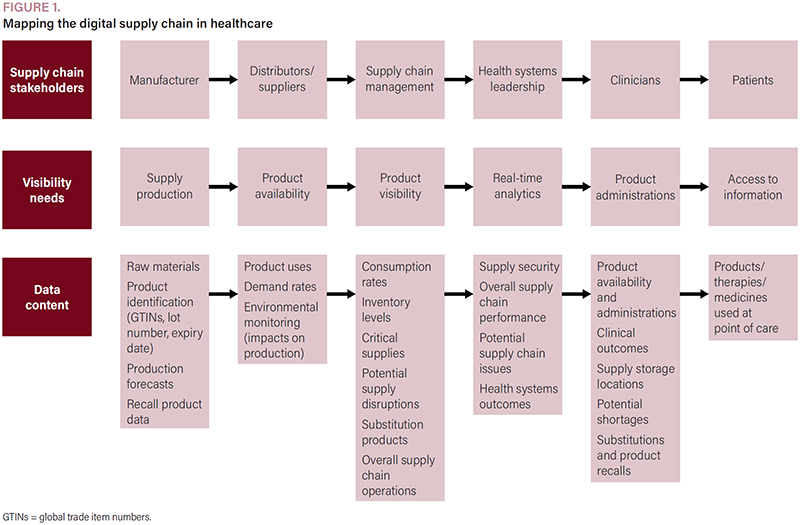
The map serves as a blueprint to guide Canada's health systems in advancing the digital supply chain to accurately verify products used in care, identify product location during emergencies, identify patient safety outcomes linked to products and support the recall of products causing harm. By establishing this flow of product data to the point of care delivery, the framework supports health systems to advance their digital infrastructure to link product data to patient care outcomes and enable data-driven decision-making for clinicians and patients.
Phase 2: Co-design strategy to advance a digitally enabled supply chain for Canadian health systems
The workgroup progressed from defining the features of a digitally enabled supply chain to identifying a strategy to advance implementation. Partners included organizations with expertise in data standards, Canadian health information agencies that report on health system performance, manufacturers, distributors, pharmacy leaders and supply chain teams.
A roundtable discussion (n = 21) was convened to examine how standardized data that uniquely identify every health product could advance a digital supply chain strategy. Roundtable strategies are well-documented to enable knowledge exchange, consensus development and the co-design of implementation strategies (Balfour et al. 2009; Ginsburg et al. 2021). In order to track and accurately identify product use during patient care, products must be accurately and easily identifiable, which is typically done using barcode scanning or radio-frequency identification (RFID) sensors to upload product identification into a patient's electronic medical record. Global data standards such as Global Trade Item Numbers (GTINs) are data standards that define up to 400 attributes of a product, such as expiry date, lot number and manufacturer (GS1 Canada 2022). Use cases for product data in health systems included documentation of product use in care processes, tracking product data to assess quality and safety of care outcomes, monitoring demand for products to better manage product inventory and supporting forecasting of supply shortages to ensure that health systems have the products needed to deliver patient care.
Use cases demonstrated the current state of product use in patient care delivery (e.g., manual identification), and how the flow of product data to the point of care enables documentation of product use during care processes (e.g., vaccines, medications), product utilization for inventory management and accurate identification of products used in care (e.g., dose and expiry date) to ensure that the right products are delivered to the right patient. These use cases informed strategies to digitally capture product data in patient health records and health system reporting frameworks.
Data collection and analysis
Workgroup meetings and roundtable discussions were recorded and transcribed through audio and video recordings, with all participants providing consent to be recorded for all meetings. Transcripts were independently reviewed and coded by members of the research team using thematic analysis comprising data familiarization, initial theme identification and iterative theme refinement (Braun and Clarke 2021a). Data were integrated during analysis, with particular attention to how mapping the digital supply chain data capture (Phase 1) aligned with strategies for implementation to advance supply chain resilience and health system performance (Phase 2). Research team discussions identified emerging themes, theme saturation and reconciled coding discrepancies to strengthen analytic rigor (Braun and Clarke 2021b).
Results
The results produced four overarching themes that identify the key features of a strategy to advance a digitally enabled supply chain for Canadian health systems, as described in the following section.
Theme 1: The value of digital supply chain to advance quality patient care
Participants examined how access to supply chain data strengthens the quality of patient care, improves patient outcomes and enhances organizational performance. The relationship between product use in care delivery and inventory management of products to ensure that they are available to support patient care delivery and clinical decision-making to ensure that the safest products are used in patient care were explored extensively. Participants shared the following examples of how the lack of access to supply chain data directly impacts patient care:
We were to begin a case [surgery] and the day before, everybody was reassured that the implant was available, [but the] implant [was] not available, and nobody knew where it was … we do not scan, we do not record barcodes, we were not keeping track of our inventory in a digital way … we have no way to track this [supplies] inside our hospital walls … [I now have to] drive an hour and a half to the [hospital] facility and then go through their storeroom with their staff to ensure that we have them [supplies], so that I do not show up there on the day of [a] surgery without the right equipment because there is no visibility. (Surgeon, Roundtable Participant)
On my first shift, a patient in the ICU [intensive care unit] needed a chest tube and everybody did not know where the kit was … Took me an hour to find all the gear I needed to put a chest tube in a patient. (Surgeon, Roundtable Participant)
The stark reality of supply chain in hospitals was captured by one hospital leader who noted the paradox of current healthcare supply chain:
[It is] safer to buy a bottle of water from our cafeteria than to actually deploy certain medical devices and implants because that bottle [of] water is traceable. Many of the things that we put into patients and that we use on patients are not. And for me sitting around the table with a bunch of grocery executives who have advances in their environment, I think, why can't we do this? (Hospital Leader)
There was widespread agreement that advancing a digitally enabled supply chain must prioritize the safety of patients and the clinical workforce. The value of documenting products used in care was described as a strategy to advance quality and safety for patients and support clinicians in delivering effective care.
Theme 2: “It is beginning with the end in mind, getting the right supplies to the people who need them”
Participants identified the absence of standardized product data capture in patient care records as a fundamental barrier to tracking quality and safety of patient outcomes. Participants described how utilization of products in care delivery could be linked to outcomes, such as access to care, wait times and safety.
It is beginning with the end in mind, which is getting the right supplies to the people that need them … the physician … the hospital. … If there are no supplies, then patient outcomes are definitely at risk. That is … why healthcare supply chain is so important. (Data Scientist Leader)
Integration of product data into patient healthcare records was identified as a strategy to enable the health workforce to deliver quality of care, efficiently:
The next step … is creating the visibility of the supplies and devices across an organization so you can identify where things are being used, and if you have too much of Widget A in this facility and it is being consumed at a greater pace at your second facility, you can then shift and move things around … how are we able to leverage data for: 1) to drive to better clinical and patient outcomes, and 2) help the organization be more efficient and effective in their care delivery. (Digital Health Leader)
Participants discussed the importance of clinicians being able to verify, with certainty, that the right product was used in patient care. Critically, integration of product data into the healthcare record ensures that products are identifiable, and patients can be confident in the quality of care and the safety of products used in care:
In the event of a recall or even a medication incident, having that ability to trace right back to the individual [product used in care] … the ability to narrow it down specifically to that patient to say, “We know you received it” versus “We think you received it.” Think about the impact that would have to a patient's peace of mind in being able to definitively know whether they were impacted or not [by a recalled product]. (Medical Device Leader)
Product data integrated into patient care records enable the use of advanced analytics to identify which products used in care achieve the best outcomes for patients. This strategy was viewed as critical to ensuring both quality care and cost-effective procurement.
Then we are able to take and combine those datasets in ways that we can put them through analytics engines and look at things like what are the outcomes from using this stent and this demographic population and create … the clinical evidence that then can … [inform] what do we want to be stocking on the shelves for our patients. (Digital Health Leader)
Participants viewed this as a breakthrough in overcoming the “mess of different data systems” by integrating globally standardized product data into the patient healthcare record, thereby building the foundation for a digitally enabled healthcare supply chain across Canada.
Theme 3: Interoperability of supply chain data across jurisdictions
Participants addressed the challenges of coordinating responses to supply shortages that impact Canadians across the country's federated jurisdictions and diverse healthcare systems. Barriers to information sharing across jurisdictions was discussed, including governance approaches that could enable interoperable flow of data (e.g., product inventory, location, utilization rates) across health systems. Participants identified data interoperability as an essential feature of the digital supply chain to overcome current fragmentation within and across health systems:
The information resides in silos and … these silos do not talk to each other. There is no way of connecting them together. There is a lot of proprietary software [in health systems] that … do not allow for that connectivity. (Medical Product Distribution Leader)
Participants envisioned seamless data portability to support coordinated care:
The patient's [health] information should be portable with them … or travels with them wherever they go, wherever they touch the healthcare system; be it institutional, be it at a clinic, be it at a family practice physician's [office] … your pharmacy … If the patient's able to carry that information with them … and it is seamlessly available to the care team in front of them, then there is a lot of benefits that start to happen. (Pharmaceutical Leader)
Pan-Canadian coordination was viewed as essential by roundtable participants:
It has to be Pan-Canadian, or [it] just does not work … how do you get them [provinces and territories] to do something that could be applied to all Canadians. (Data Scientist Leader)
[We need] data that connects 15 healthcare systems in Canada to one truly Pan-Canadian health [information] system. (Digital Health Leader)
Participants identified the importance of the flow of data across jurisdictions as a feature of the digital supply chain that creates the opportunity for strengthening health system performance.
Theme 4: Critical product data elements as a foundational element to advance quality of care delivery
Participants defined the data elements required to operationalize and advance a digitally enabled supply chain across Canadian jurisdictions. The clinical need for product data integrated into patient care documentation led participants to a clear consensus on specific data points that would be essential to support quality patient care. Participants identified the many outcomes that are achievable when product data are integrated into the patient record, and available to clinicians to inform care decisions:
They [clinicians] need to know if there is potential for [product] shortages. They need to know about substitutions and recalls. They need to know where supplies are located … for the patient, they need [information on] product therapies and medications that were used [in care delivery]. (Digital Health Leader)
Critical data elements needed to identify a product included the lot number and expiry date, which informs clinical decisions (e.g., surgeons) of whether products are safe for use in patient care.
I think that is really where we landed in terms of scope … The GTIN [global trade item number], the lot [number], the expiry [date], [and the] serial number. (Health Information System Leader)
It is so important to get the data right … because #1 safety and #2 security of supply … having this extra level of data would allow everyone … to make important decisions in real time. (Medical Product Distribution Leader)
Critically, participants emphasized that these data elements must be embedded at the point of manufacturing and consistently tracked across the global supply chain to enable traceability of products used in care, from manufacturer to patient outcomes:
The manufacturer puts them on the labels on the different packaging levels and makes that available to federal, provincial [and] municipal government. (Vaccine-specific Expertise Perspective, Roundtable Participant)
Discussion revealed critical insights into how jurisdictions across Canada could advance the digital supply chain, guided by the key data elements included in the Pan-Canadian Health Data Content Framework (CIHI 2025). This strategy creates the opportunity to support the integration of product data into patient health records for every Canadian. Ultimately, it enables documentation of products used in care delivery linked to quality and safety outcomes for patients, and supports tracking of product utilization to ensure that health systems have the products needed to deliver care to Canadians when and where they are needed.
Discussion
As Canada faces the highest number of supply disruptions of any country in the world, and given that the duration of these disruptions lasts longer than any other country, the lack of product data in patient care documentation has emerged as a foundational barrier to safe patient care and resilient supply chain management across Canada (Health Canada 2024). The traceability of health product data from manufacturer to patient health outcomes offers a playbook for each jurisdiction to advance supply chain resilience across Canada.
The results of this study underscore the patient safety imperative of advancing digitally enabled supply chain infrastructure. Examples of surgeons driving hours to manually verify the availability of the correct implant and intensive care unit staff spending time searching for chest tubes and emergency equipment demonstrate the significant burden clinicians experience in current health systems when products and supplies are not readily available when needed for care delivery. These findings align with previous research documenting care compromises during supply shortages, and patient harm where delays or cancellations of treatment are the only option (Snowdon et al. 2024).
The results of this study offer a practical approach to integrating standardized product data into patient health records and to digitally enable health system reporting to more fully document the quality and safety of care delivery. The majority of Canadian health systems report their performance data to the Canadian Institute for Health Information (CIHI), which is leading the Pan-Canadian Health Data Content Framework strategy. Integration of product data into patient health records ensures that health systems and CIHI can monitor safety and quality of care outcomes linked to product use for every Canadian.
Implementation of product data that are globally relevant positions Canada to better document products used in care and the safety and quality outcomes of care linked to product use, and identify risks to patients when product supply is disrupted and not available to support patient care. This integration of product data into individual patient care records offers leaders insights into the products used in care, where products are located, which patients are at highest risk during product shortages and which products are associated with the best safety outcomes. Digital supply chain enables supply chain teams to accurately identify the products needed to deliver care, where they are needed and what inventory volume must be maintained to ensure that health systems have the capacity to meet the healthcare needs of patients. The digital supply chain strategy proposed in this study offers the opportunity for real-time tracking of product use and future forecasting of product demand to identify patients at risk when products are in shortage and to inform equitable distribution of products to patients at greatest risk. Predictive analytics to forecast demand and inform more resilient supply management strategies ensures that products are available when and where needed.
Integration of product data into patient records offers national visibility of product use and product recalls to inform clinicians and health system leaders to monitor outcomes (e.g., readmissions, infections, complications) related to recalled products used in care delivery. Integration of product data into the Pan-Canadian Health Data Content Framework may be a key enabler that addresses the challenge of identifying safety outcomes of product use in care delivery (Canadian Medical Association et al. 2024; Kelley et al. 2021). Currently, if an implant, medication or device is recalled, there is no digital infrastructure that can identify which patients received the recalled product, and how best to contact them to support risk mitigation of potential harmful outcomes. Digital tracking of the precise location and use of products in patient care enables efficient removal of recalled products when they are found to cause harm.
From vision to implementation: The critical digital supply chain blueprint
The digital supply chain strategy provides a playbook for how product data elements can seamlessly flow from manufacturer to patient outcomes, establishing a blueprint for advancing both patient safety imperatives and supply chain resilience across Canada. The opportunity to integrate product data elements into the patient record establishes the foundation for “end-to-end” supply chain traceability that positions Canadian jurisdictions to support proactive management of healthcare supply chain disruptions and ensure that every Canadian has access to safe and quality care, when and where it is needed.
The key features of a digital supply chain and the integration of product data into patient care records offer Canadian health systems a strategic roadmap that aligns with current federal and provincial data modernization efforts. At the provincial and territorial level, a digitally enabled supply chain can advance collaboration across jurisdictions to better coordinate efforts to manage widespread supply disruptions (e.g., pandemic preparedness). At the national level, a digitally enabled supply chain enables interoperability of supply data to support a more resilient and coordinated supply chain strategy across Canada to prevent, or proactively manage, supply shortages focused on reducing and eliminating risks for patients who require access to care.
Conclusion
This study offers a robust digital healthcare supply chain strategy that establishes accurate product data integrated into patient health records to identify quality and safety of care outcomes linked to product use within and across healthcare systems. The digital supply chain strategy also offers a strategic roadmap to strengthening supply chain resilience by tracking product availability, inventory levels and supply disruption risks for patients, which enables health system leaders to effectively and equitably distribute products to patients in need. Of critical importance is the underlying principle of healthcare supply chain, the end of which is a person's life. As Canada advances its national agenda to strengthen health system performance, supply chain resilience must be recognized as foundational for ensuring that health systems in every Canadian jurisdiction have the capacity (e.g., the products needed) to deliver safe and quality care to every citizen.
About the Author(s)
Anne W. Snowdon, PhD, is a professor of Strategy and Entrepreneurship at the Odette School of Business, University of Windsor, Windsor, ON. She can be reached by e-mail at anne.snowdon@uwindsor.ca.
Alexandra Wright, PhD, is a research director at the Supply Chain Advancement Network in Health, Odette School of Business, University of Windsor, Windsor, ON.
Colleen J. Metge, BSc (Pharm), PhD, is a health services researcher and associate professor in the Department of Community Health Sciences, Max Rady College of Medicine, University of Manitoba, Winnipeg, MB.
Nancy L. Pakieser, BSc, is the principal at the Capstone 406, LLC, Chandler, AZ.
Cindy Ly, MA, is a research analyst at the Supply Chain Advancement Network in Health, Odette School of Business, University of Windsor, Windsor, ON.
Saba Ghadiri, BEng, MA, is a research analyst at the Supply Chain Advancement Network in Health, Odette School of Business, University of Windsor, Windsor, ON
References
Balfour, D.C., S. Evans, J. Januska, H.Y. Lee, S.J. Lewis, S.R. Nolan et al. 2009. Health Information Technology – Results From a Roundtable Discussion. Journal of Managed Care Pharmacy 15(1 Suppl): S10–17. doi:10.18553/jmcp.2009.15.s1.10.
Barrett, D. and R. Heale. 2020. What Are Delphi Studies? Evidence-Based Nursing 23(3): 68–69. doi:10.1136/ebnurs-2020-103303.
Beaulieu, M. and O. Bentahar. 2021. Digitalization of the Healthcare Supply Chain: A Roadmap to Generate Benefits and Effectively Support Healthcare Delivery. Technological Forecasting and Social Change 167: 120717. doi:10.1016/j.techfore.2021.120717.
Beaulieu, M., J. Roy, C. Rebolledo and S. Landry. 2022. The Management of Personal Protective Equipment During the COVID-19 Pandemic: The Case of the Province of Quebec. Healthcare Management Forum 35(2): 48–52. doi:10.1177/08404704211053996.
Braun, V. and V. Clarke. 2021a. Can I Use TA? Should I Use TA? Should I Not Use TA? Comparing Reflexive Thematic Analysis and Other Pattern-Based Qualitative Analytic Approaches. Counselling and Psychotherapy Research 21(1): 37–47. doi:10.1002/capr.12360.
Braun, V. and V. Clarke. 2021b. To Saturate or Not to Saturate? Questioning Data Saturation as a Useful Concept for Thematic Analysis and Sample-Size Rationales. Qualitative Research in Sport, Exercise and Health 13(2): 201–16. doi:10.1080/2159676x.2019.1704846.
Canadian Institute for Health Information (CIHI). 2023, August. Better Access to Electronic Health Information Key to Improving Health Systems. Retrieved June 1, 2025. <https://www.cihi.ca/en/taking-the-pulse-a-snapshot-of-canadian-health-care-2023/better-access-to-electronic-health>.
Canadian Institute for Health Information (CIHI). 2025, March. Pan-Canadian Health Data Content Framework and CACDI. Retrieved June 1, 2025. <https://www.cihi.ca/en/connected-care/pan-canadian-health-data-content-framework-and-cacdi>.
Canadian Medical Association, College of Family Physicians of Canada, Royal College of Physicians and Surgeons of Canada and Canada Health Infoway. 2024, November. Digital Health Interoperability Task Force Report. Retrieved June 1, 2025. <https://www.infoway-inforoute.ca/en/component/edocman/6498-digital-health-interoperability-task-force-report/view-document?Itemid=103>.
Casey, S. 2023, November. Strengthening the Oversight of Breast Implants. Standing Committee on Health. Retrieved June 1, 2025. <https://www.ourcommons.ca/documentviewer/en/44-1/HESA/report-16>.
Ginsburg, G., M. Penny, W.G. Feero, M. Miller, S. Addie and S.H. Beachy. 2021. The National Academies' Roundtable on Genomics and Precision Health: Where We Have Been and Where We Are Heading. The American Journal of Human Genetics 108(10): 1817–22. doi:10.1016/j.ajhg.2021.08.015.
GS1 Canada. 2022. Healthcare: Global Trade Item Number (GTIN). Retrieved June 1, 2025. <https://www.gs1ca.org/pages/n/healthcare/gtin.com>.
Health Canada. 2024, June. Building Resilience: Health Canada's Plan to Address Health Product Shortages, 2024 to 2028. Government of Canada. Retrieved June 1, 2025. <https://www.canada.ca/en/health-canada/services/drugs-health-products/drug-products/drug-shortages/plan-2024-2028.html>.
Health Canada. 2025, March. Drug Shortages in Canada. Government of Canada. Retrieved June 1, 2025. <https://www.canada.ca/en/health-canada/services/drugs-health-products/drug-products/drug-shortages.html>.
Jarrett, S., T. Wilmansyah, Y. Bramanti, H. Alitamsar, D. Alamsyah, K.R. Krishnamurthy et al. 2020. The Role of Manufacturers in the Implementation of Global Traceability Standards in the Supply Chain to Combat Vaccine Counterfeiting and Enhance Safety Monitoring. Vaccine 38(52): 8318–25. doi:10.1016/j.vaccine.2020.11.011.
Kelley, L., D. Zarn, V. Kishimoto and T. Jamieson. 2021. Five Policy Recommendations for the Canadian Federal Government to Accelerate the Growth and Impact of Digital Health. The School of Public Policy Publications 14(38): 1–27. doi:10.11575/sppp.v14i1.74019.
Lanza-Leon, P., L. Sanchez-Ruiz and D. Cantarero-Prieto. 2021. Kanban System Applications in Healthcare Services: A Literature Review. The International Journal of Health Planning and Management 36(6): 2062–78. doi:10.1002/hpm.3276.
Marchildon, G.P., S. Allin and S. Merkur. 2020. Canada: Health System Review. Health Systems in Transition 22(3). Retrieved June 1, 2025. <https://iris.who.int/bitstream/handle/10665/336311/HiT-22-3-2020-eng.pdf>.
Metge, C.J. and M.A. Islam. 2022. Manitoba 2020: How Centralizing the Healthcare Supply Chain Helped With Pandemic Management. Healthcare Management Forum 35(2): 86–89. doi:10.1177/08404704211057055.
Miller, A.P., K. Ross, E.M. Brown, C. Chandrasena and O. Bhattacharya. 2025. Interoperability of Health Data: The Importance of Including Physicians. CMAJ 197(7): E192. doi:10.1503/cmaj.151780-l.
Pathak, R., V. Gaur, H. Sankrityayan and J. Gogtay. 2023. Tackling Counterfeit Drugs: The Challenges and Possibilities. Pharmaceutical Medicine 37: 281–290. doi:10.1007/s40290-023-00468-w.
PharmaCompass. 2023, June 15. Drug Shortages Reach Record High Amidst Changing Regulatory Environment. Retrieved June 1, 2025. <https://www.pharmacompass.com/radio-compass-blog/drug-shortages-reach-record-high-amidst-changing-regulatory-environment>.
Snowdon, A. 2018. Global Standards: Helping Save Time, Money and Lives. GS1 Canada. Retrieved June 1, 2025. <https://gs1ca.org/healthcare/standards-save/>.
Snowdon, A., C. Ly and A. Wright. 2024. Resilience Among Family Physicians During the COVID-19 Pandemic in Canada. Healthcare Management Forum 38(3): 234–40. doi:10.1177/08404704241302717.
Snowdon, A. and A. Wright. 2022a. Digitally Enabled Supply Chain as a Strategic Asset for the COVID-19 Response in Alberta. Healthcare Management Forum 35(2): 90–98. doi:10.1177/08404704211057525.
Snowdon, A.W. 2022. Advancing Supply Chain Resilience for Canadian Health Systems. The School of Public Policy Publications 5(1): 1–24. doi:10.1177/08404704241302717.
Snowdon, A.W. and P.-G. Forest. 2021. “Flying Blind”: Canada's Supply Chain Infrastructure and the COVID-19 Pandemic. Healthcare Quarterly 23(4): 12–16. doi:10.12927/hcq.2020.26399.
Snowdon, A.W., M. Saunders and A. Wright. 2021. Key Characteristics of a Fragile Healthcare Supply Chain: Learning From a Pandemic. Healthcare Quarterly 24(1): 36–43. doi:10.12927/hcq.2021.26467.
Snowdon, A.W. and A. Wright. 2022b. Supply Chain Capacity to Respond to the COVID-19 Pandemic in Ontario: Challenges Faced by a Health System in Transition. Healthcare Management Forum 35(2): 53–61. doi:10.1177/08404704211057664.
Yang, J. 2024. Number of Hospital Establishments in Canada as of 2024, by Province. Statista. Retrieved June 1, 2025. <https://www.statista.com/statistics/440923/total-number-of-hospital-establishments-in-canada-by-province/>.
Zhang, J., C. Mitchell, A. Kushniruk and A. Guitouni. 2022. Facing Disruption: Learning From the Healthcare Supply Chain Responses in British Columbia During the COVID-19 Pandemic. Healthcare Management Forum 35(2): 80–5. doi:10.1177/08404704211058968.
Zingde, S. and N. Shroff. 2021. Enhancing Healthcare Supply Chain Performance Through Barcoding and Business Intelligence. International Journal for Research in Engineering Application and Management 6(12): 206–15. doi:10.35291/2454-9150.2021.0112.
Comments
Be the first to comment on this!
Personal Subscriber? Sign In
Related Articles


Note: Please enter a display name. Your email address will not be publically displayed